Singapore Art Museum presents more than six decades of thought provoking works examining consciousness, memory, and the nature of reality.
A Landmark Exhibition Arrives In Singapore
Singapore Art Museum is hosting Hiroshi Sugimoto: Form Is Emptiness, the acclaimed Japanese artist’s first major survey exhibition in Southeast Asia. Running from May 29 through October 4, 2026, the exhibition brings together more than 60 works spanning 11 series, alongside 14 rare fossil specimens from Sugimoto’s personal collection.
Born in Tokyo in 1948, Sugimoto has spent over five decades exploring themes of time, perception, and human consciousness through photography, sculpture, installation, and spatial design. Inspired by Buddhist philosophy and the Heart Sutra’s concept that “form is emptiness,” the exhibition itself was designed by Sugimoto as a mandala, creating a meditative environment that guides visitors through interconnected paths representing the cyclical nature of life.
Iconic Works Meet New Creations
Among the highlights are several of Sugimoto’s most celebrated series. His long running Seascapes project reduces the world to a simple horizon line dividing sea and sky, while Theaters compress entire films into a single glowing frame using long exposure photography. The Opticks series revisits Isaac Newton’s experiments with light, transforming white light into immersive fields of color.
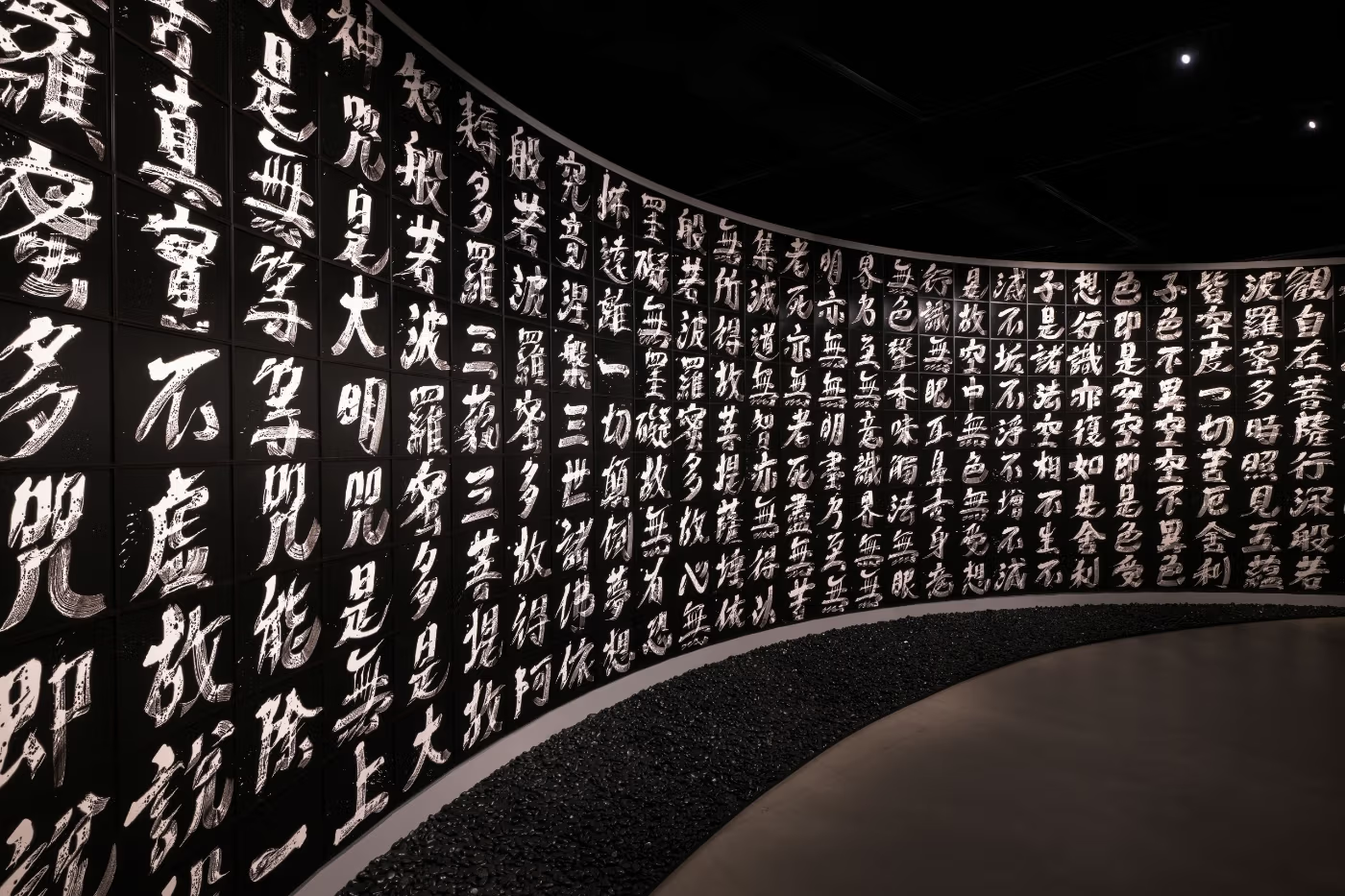
The exhibition also debuts new works, including Spacescape (2024), a folding screen depicting Earth and the Moon in orbit that was developed with the Japan Aerospace Exploration Agency, the University of Tokyo, and Sony. Visitors can also experience Brush Impression, Heart Sutra (2023), a monumental installation composed of 288 gelatin silver prints created through a unique photographic process.
Exploring Time Beyond Human Experience
Beyond traditional photography, Form Is Emptiness expands Sugimoto’s investigation into time through video installations and natural artifacts. His first video work, Accelerated Buddha (1997–2017), appears alongside a selection of fossil specimens that the artist describes as “pre photography time recording devices.”
Together, these works challenge viewers to reconsider how time is measured and experienced. By connecting ancient history, scientific exploration, and spiritual philosophy, Hiroshi Sugimoto’s expansive survey offers a rare opportunity to engage with one of contemporary art’s most thoughtful and enduring voices.