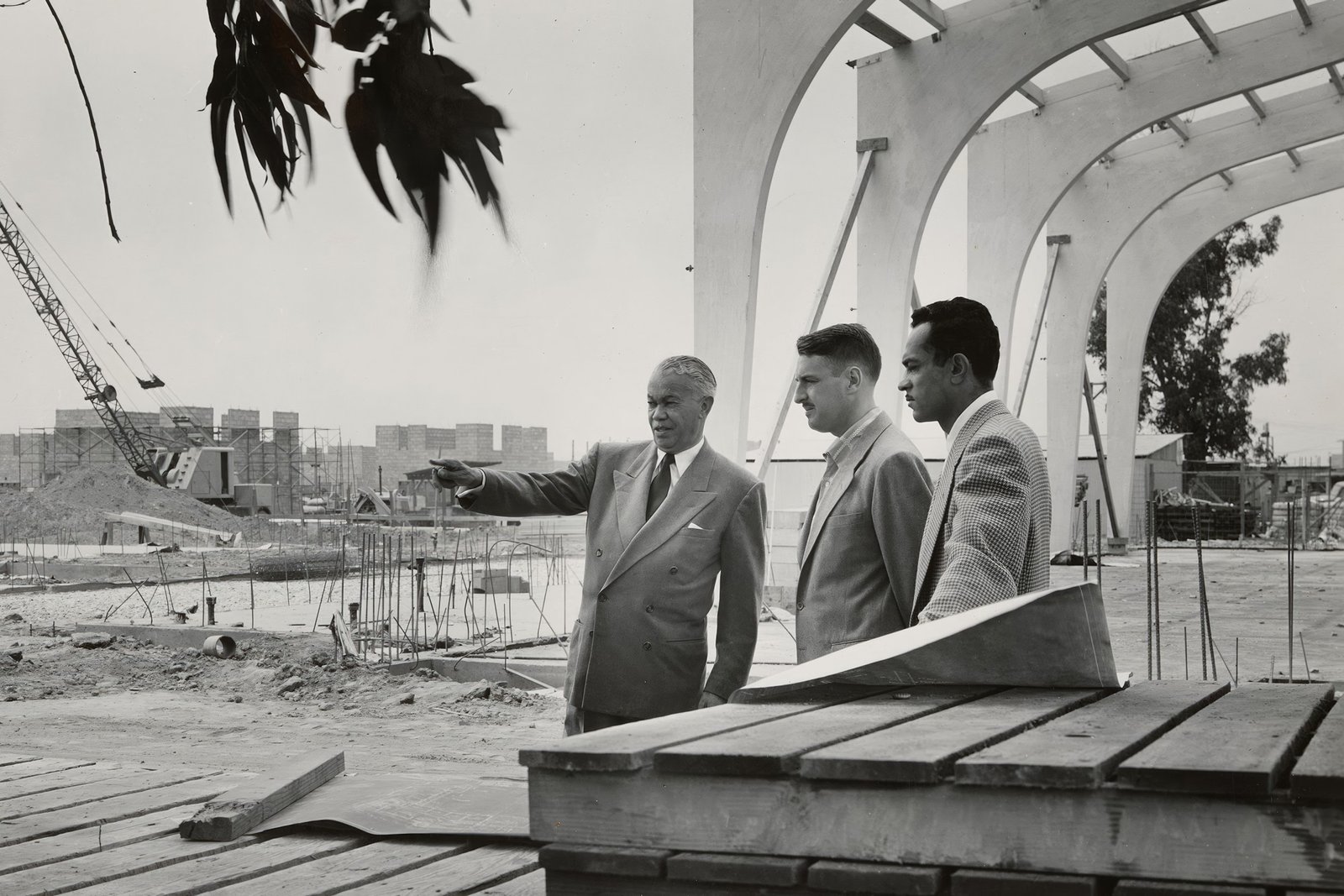
Paul R. Williams Architect: The most prominent Black American architect of his generation finally gets the major museum retrospective Los Angeles has owed him.
Paul R. Williams architect shaped Los Angeles without most people knowing his name. The buildings he designed between the 1920s and 1970s defined how the city looks, how it functions, and how people live within it. Now, on November 15, LACMA opens “Paul R. Williams: Architect for Living” at its Miracle Mile location, and it marks the first major museum retrospective for a figure who should have had one decades ago.
Williams was the most prominent Black American architect of his generation. That fact alone carries weight in a profession and a city where recognition has historically been distributed along narrow lines. But the real story isn’t about overdue representation, though that matters. It’s about the actual buildings he created, the residential neighborhoods he shaped, and the institutions he left behind that continue to structure life in Southern California.
Paul R. Williams Architect: The Man Who Built LA Without the Credit
Williams worked during an era when architectural fame went to white men whose names appeared in every publication. He built homes for Hollywood figures and business leaders, designed office buildings and places of worship, and created lasting neighborhoods. Yet his name remained largely absent from major institutional recognition until now. The exhibition at LACMA serves as a correction, not a celebration of diversity for its own sake, but a genuine acknowledgment of architectural importance that was overlooked for too long.
The timing of this show reflects a broader shift in how institutions are reckonming with cultural history. But what makes it significant is that Williams’ work holds up architecturally. His buildings are not being reexamined because they’re historically important. They’re being examined because they’re architecturally intelligent, spatially sophisticated, and they still work. A home he designed in the 1930s functions as beautifully today as it did then because the design principles were sound from the beginning.
From Museum Show to City Tour
LACMA isn’t positioning this as a standalone event. On Saturday, November 21, the LA Conservancy, in partnership with SoCal NOMA and LACMA, is hosting “Paul Revere Was Here: On the Trail of Paul R. Williams.” It’s a driving tour that takes visitors through the actual city, moving from a family home to places of worship to an office building. These aren’t photographs or models or archival drawings. They’re the buildings themselves, still in use, still inhabited, still functioning in the everyday life of Los Angeles.
This kind of follow-up programming is essential context for an architect whose work is inseparable from the city itself. You can’t fully understand Williams’ contribution by looking at renderings or construction documents. You have to see how a residential block develops around one of his homes, how a church he designed serves a community, how an office building he created sits within a streetscape. The tour fills that gap between exhibition and experience.
Why This Matters Now
The story of Paul R. Williams is not a contemporary story. He wasn’t just recognized recently. He’s been recognized within certain circles for decades. What’s changed is that those circles have expanded. LACMA opening a major retrospective signals that his work is being integrated into the larger narrative of American architecture and Los Angeles history, not kept in a specialized corner.
For anyone who lives in Los Angeles and pays attention to the built environment, this exhibition offers clarity. How many buildings have you passed without knowing who designed them? How many residential streets have you driven through without understanding the architectural choices that shaped them? Williams designed thousands of structures. Some are famous. Most aren’t. All of them deserve examination, and all of them shaped how the city developed.
The exhibition opens November 15 at LACMA. The driving tour follows on November 21. Neither is optional if you care about architecture, Los Angeles, or the history of American design. What’s worth noting is that this retrospective exists at all. For a long time, it didn’t. Now it does. That’s the story.