Es Devlin Retrospective: The Olivier and Tony Award-winning set designer who transformed stages for Rihanna and the 2012 Olympics gets her first-ever solo institutional show.
The Es Devlin retrospective has finally arrived, documenting three decades of the British set designer and artist building impossible worlds on stages most of us will never set foot on. Yet her influence seeps into every corner of contemporary visual culture. She has won Olivier Awards, Tony Awards, and Grammy Awards. She designed the opening ceremony for the 2012 London Olympics. She built the stages for Rihanna’s ANTI World Tour. She’s created immersive installations in museums and public spaces. She’s collaborated with Björk, worked with the London National Theatre, and shaped how we experience live performance at a scale that reaches millions. And until now, she’s never had a proper retrospective.
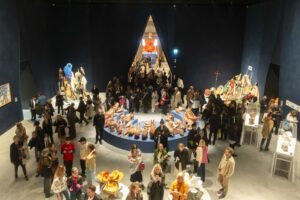
That changes with the opening of “Es Devlin: Other Worlds” at the Design Museum in London. This is not a minor career milestone. This is institutional validation of what insiders have known for years: Devlin operates at the intersection of sculpture, architecture, theater, and technology in ways that dissolve the boundaries between those disciplines entirely. The retrospective marks her first-ever solo show at a museum of this scale, and it arrives as a necessary correction to a gap in how we’ve documented the work of one of the most consequential designers of our time.
The career that led here reads like a masterclass in scale and ambition. Early in her practice, Devlin established herself as someone who didn’t think in terms of conventional stagecraft. Her installations and sets reject the idea that design should be decorative or subordinate to performance. Instead, she treats the stage itself as a protagonist, a space that shapes how meaning is made and how bodies move through it. The 2012 Olympic opening ceremony alone demonstrated this: the stage wasn’t a backdrop. It was an actor. The architectural interventions she created didn’t support the performance so much as become inseparable from it.
What makes Devlin’s work particularly difficult to categorize, and perhaps why a retrospective took this long to materialize, is that she refuses to stay in one lane. A Rihanna tour stage is not the same type of problem as an installation for a museum or a theater production, yet Devlin approaches each with the same conceptual rigor. She thinks spatially. She thinks about how light sculpts form. She considers the relationship between the performer, the audience, and the architecture that holds them both. These concerns repeat across contexts, but they’re never recycled. Each project generates its own language.
The Design Museum’s decision to mount this retrospective now, at this moment in her career, reflects a broader cultural shift in how we value design that operates at the scale of experience rather than the scale of the object. We’re living through a period where the most culturally significant design practice is often invisible to traditional design criticism because it happens in ephemeral spaces, in performance, in the temporary and the immersive. Devlin has been working at this frontier for decades. A retrospective doesn’t just honor past work; it legitimizes an entire category of practice that museums have historically struggled to frame.
“Other Worlds” also arrives at a moment when the distinction between high art and entertainment design has collapsed almost entirely. Devlin has never respected that distinction. The fact that she’s won Grammys for her work with musicians alongside her Olivier Awards for theater work is not a contradiction in her practice; it’s a reflection of her actual worldview. She sees all these contexts as legitimate fields for serious spatial and temporal experimentation. A museum retrospective that gathers work across all these domains doesn’t flatten them into equivalence so much as it reveals the underlying principles that connect them.
What remains to be seen is how the Design Museum translates Devlin’s practice, which is fundamentally about the experience of moving through space and time, into the museum format. How do you exhibit work that only fully exists in performance? How do you communicate the impact of a stage design that was meant to be experienced live, in a crowd, with music and bodies and light all working together? This isn’t a new problem for museums, but it’s a crucial one. The quality of the retrospective will depend not just on what work gets included, but on how thoughtfully the museum has grappled with the gap between Devlin’s actual practice and the act of displaying it in a gallery.
What remains to be seen is how the Design Museum translates Devlin’s practice, which is fundamentally about the experience of moving through space and time, into the museum format. How you exhibit the ephemeral and the experiential within the constraints of gallery walls will determine whether this Es Devlin retrospective achieves what it sets out to do: legitimizing an entire category of design practice that has historically operated outside traditional institutional frameworks, and demonstrating that stage architecture deserves the same critical attention as any other form of spatial practice.