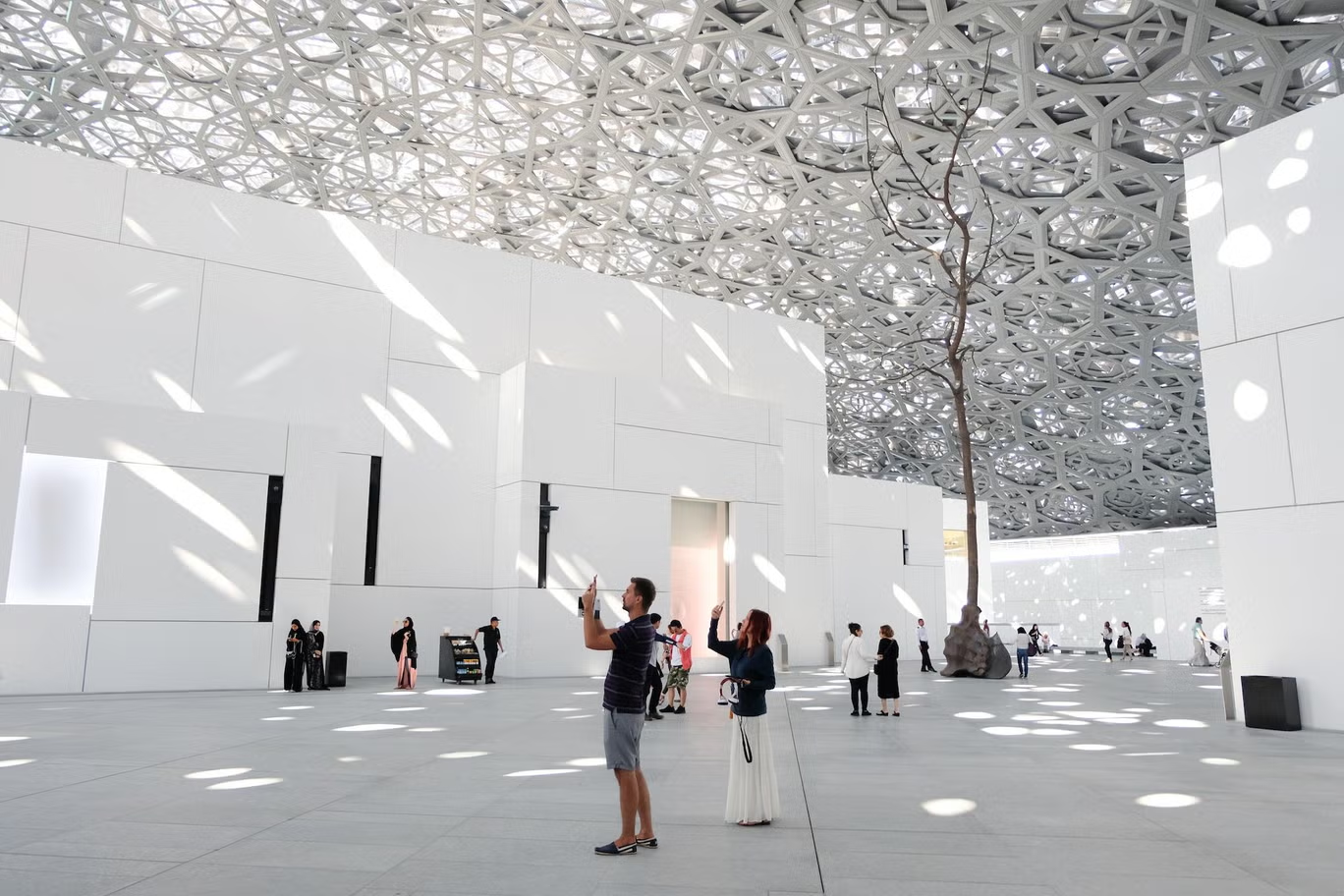
Art Here 2026 Confluences: The Gulf’s most ambitious annual art commission spotlights a new generation of regional voices as Abu Dhabi cements its place in a fast-maturing autumn calendar.
The autumn art and design calendar stretching across Europe, the Middle East, and beyond has become something unprecedented: a true conversation between continents. At the centre of this shift sits the Louvre Abu Dhabi’s latest iteration of its flagship annual commission, Art Here 2026 Confluences, a project that doubles down on the institution’s role as a connector between Gulf and Indian artistic practices. From early September through the end of November, a cascade of openings from Paris and London through Istanbul, Riyadh, Amman, Dubai, Doha, Abu Dhabi, Cairo, and Venice reveals a season defined less by isolated events and more by genuine cultural exchange.
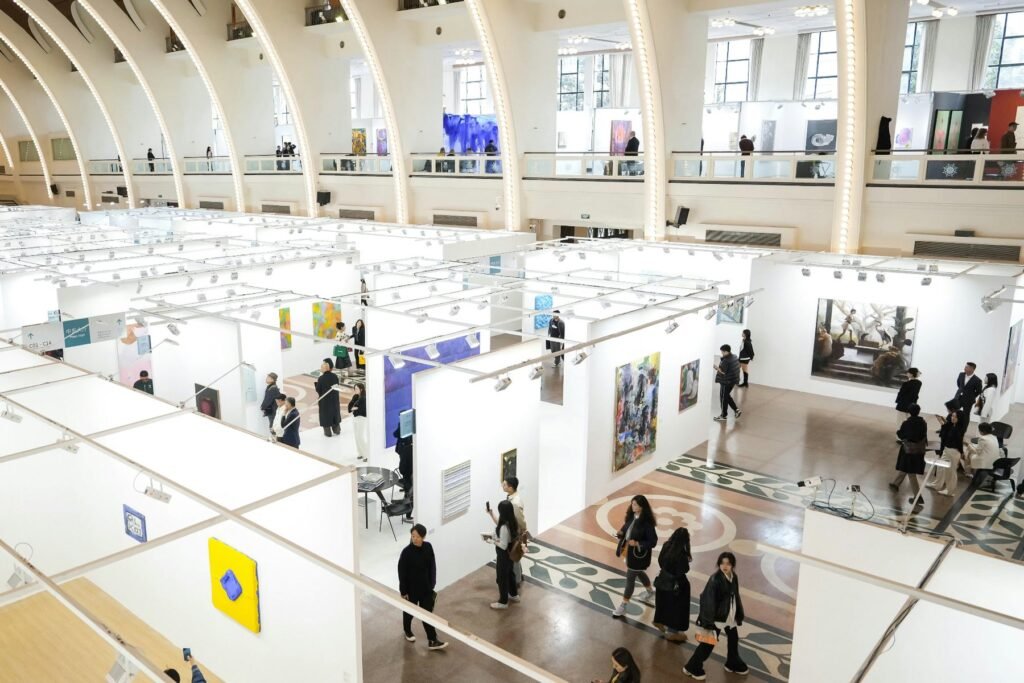
The timing matters more than usual this year. These exhibitions don’t exist in isolation; read together across the calendar, they chart a maturing Gulf and Levantine art ecosystem standing increasingly confident alongside Europe’s established museum and fair infrastructure. The Grand Palais reopens in Paris in September with a Cézanne survey and its attendant contemporary conversations. Tate Britain debuts a new survey in October curated by Edward Enninful. Istanbul’s Galerist celebrates its twenty-fifth anniversary in October with a retrospective spanning more than fifty artists who have defined its programme, among them Nil Yalter, Hussein Chalayan, Thomas Ruff, Michael Craig-Martin, Erwin Wurm, and Julian Opie. But alongside these European anchors sits an expanded Gulf calendar that has become impossible to ignore.
Art Here 2026 Confluences and a Region’s Artistic Coming of Age
Riyadh’s design fair arrives in September at the JAX District, the creative quarter built around the UNESCO-listed site of Al Turaif, with an expanded showcase of regional and international galleries and studios as Saudi Arabia’s design ecosystem continues to scale. Amman Design Week returns for its fourth edition under the theme “Accumulations,” running for a full sixteen days rather than a compact weekend, marking how far Jordan’s design scene has developed since the event first launched in 2016. In Dubai, the Jameel Arts Centre opens new solo presentations from Lulua Alyahya, Shezad Dawood, and Walid Siti beginning 20 September 2026, running through 31 January 2027, offering a quieter counterpoint to Dubai’s fair-week noise and giving the city’s artist-led programming room to breathe before November’s crowds arrive.
What Art Here 2026: Confluences signals, though, is a deliberate centering of voices often positioned at the margins of that European conversation. The commission’s focus on GCC and Indian artists reflects an artistic reality that Gulf institutions have been building quietly for years: the most compelling contemporary practices aren’t always emanating from New York or London anymore, and audiences in Abu Dhabi don’t need to look only westward to find them. The Louvre Abu Dhabi’s annual commission has become the Gulf’s most ambitious platform for this recalibration, using the legitimacy of its museum status and the weight of its annual cycle to consistently elevate artists whose work speaks to the region’s actual artistic preoccupations rather than its assumed ones.
The Commission Format as Cultural Statement
The annual commission structure itself carries weight. By anchoring an entire curatorial project around contemporary voices from the Gulf and India, the Louvre Abu Dhabi stakes a claim about what museum programming should do in this particular moment: reflect the audiences it serves, the artists it’s neighbour to, and the conversations happening in real time rather than those inherited from previous institutional models. This isn’t a “diversity initiative” bolted onto an existing program; it’s the program. The specificity of the focus, not simply “contemporary art” or “emerging artists,” but deliberately GCC and Indian practitioners, narrows the frame in a way that actually opens it up, creating permission for depth rather than gesture.
The autumn calendar itself becomes a backdrop that makes Art Here 2026 read differently than it might in isolation. When Galerist celebrates its quarter-century by bringing together fifty artists spanning painting, textiles, video, and installation inside its nineteenth-century Pera district home, the message is heritage and lineage. When Paris opens the Grand Palais and Istanbul and London and Amman all present their own institutional narratives simultaneously, the question becomes not whether the Gulf belongs in that conversation, but whether that conversation has finally caught up to the Gulf’s own conversation with itself. Art Here 2026: Confluences answers that question before it’s even asked.
Sources: maison.marieclairearabia.com