Luxeed Luxury Ev: A Huawei-backed startup reveals its design philosophy and two flagship electric vehicles to the world, positioning itself as a challenger in the premium EV segment.
On November 7, 2026, LUXEED luxury EV brand made its global entrance by unveiling two vehicles that crystallize a singular vision: what happens when a Chinese tech giant decides the future of premium automobiles belongs to electric vehicles engineered with smartphone-level precision and design ambition. The LLounge and Stormax represent the brand’s opening statement, each designed to occupy distinct territory within the luxury EV market while sharing a coherent design language developed by the startup.
The global brand launch functioned as something more than a product reveal. LUXEED took the stage to articulate its core design DNA and tech architecture, the foundational thinking that will guide everything the brand builds going forward. This isn’t a company releasing two cars; it’s a company declaring how it will approach the entire category. The fact that Huawei backs this effort carries weight in how seriously to read the moment. Huawei has already proven itself capable of competing at the premium level through smartphone manufacturing, and vehicles present the next logical expansion for a company with expertise in semiconductors, battery management systems, and software integration.
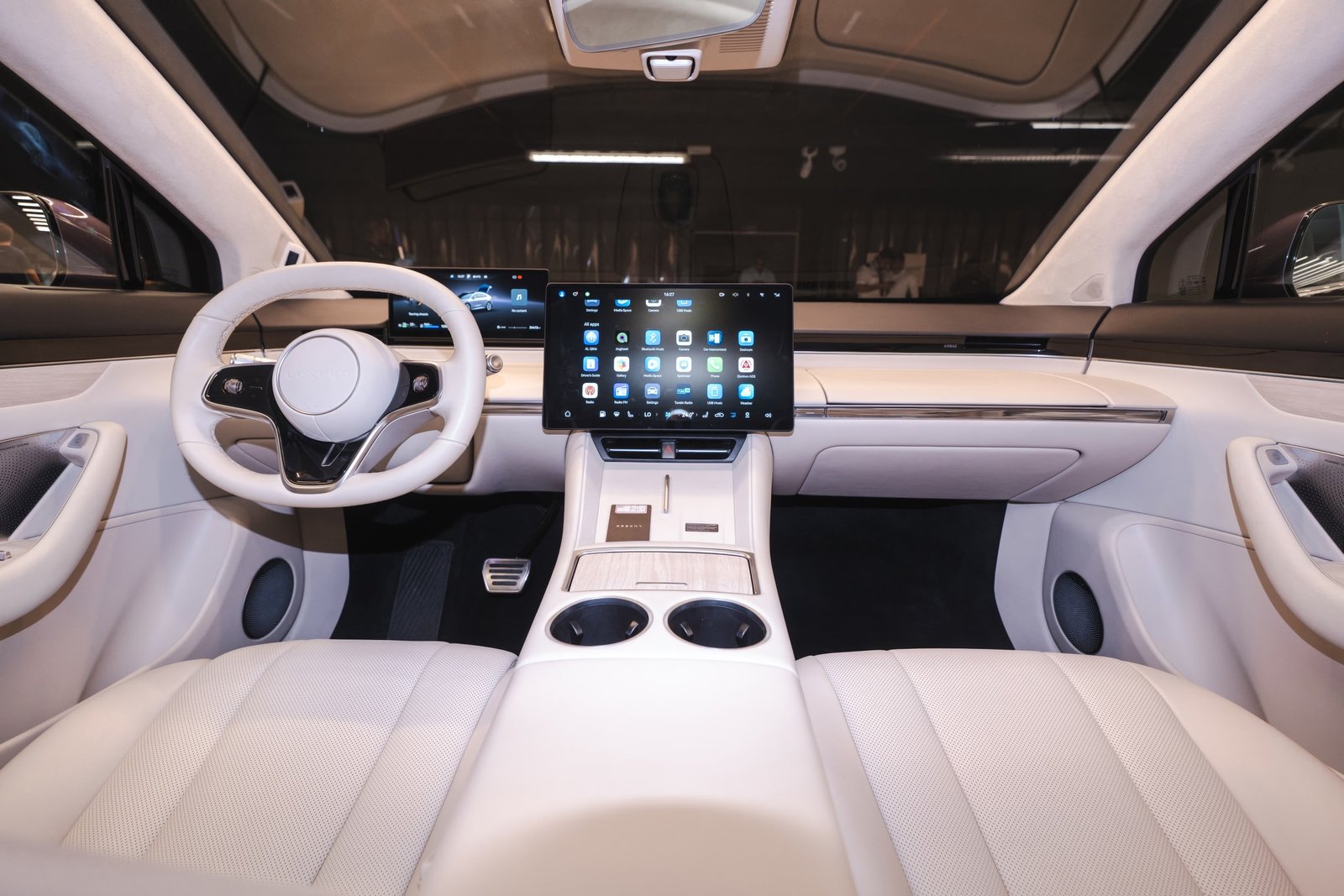
The LLounge arrives as a statement of what LUXEED believes a modern luxury sedan should be. Without access to the exact specifications, the name itself suggests a vehicle oriented toward ease and refinement, a space as much as a means of transportation. In the EV segment, where traditional sedan sales have contracted in favor of SUVs and crossovers, positioning a model as a lounge requires confidence in your design and engineering. The message is clear: LUXEED intends to prove that electric sedans can deliver the sense of occasion and purpose that luxury buyers expect.
Alongside the LLounge sits the Stormax, a vehicle name that implies practicality without sacrificing the premium positioning. In the context of LUXEED’s global launch, the Stormax likely represents the company’s interpretation of what a modern luxury utility vehicle could be, an EV designed for buyers who want capability and space alongside the technology and craftsmanship associated with a prestige marque. The dual release demonstrates LUXEED’s intent to serve multiple buyer personas from day one, refusing to be positioned as a single-segment specialist.
The design DNA that LUXEED revealed on November 7 will become the visual and conceptual grammar for the brand’s future. This moves beyond styling cues or color palettes. Design DNA in the EV context encompasses how a vehicle uses proportion and volume, how it communicates its electrical nature through form, how it balances the demands of aerodynamics with the desire for distinctive presence. It’s the architectural thinking that allows future LUXEED vehicles to feel part of a family without requiring specific trim elements or badge swaps.
The tech architecture announcement carries equal weight. How LUXEED structures its computing platform, battery integration, and software ecosystem will determine everything from charging speed to over-the-air update capability to how the vehicle responds to driver input. In a market where Tesla has set expectations for rapid software iteration and where Chinese manufacturers have demonstrated aggressive development cycles, LUXEED’s tech foundation will either position the brand as genuinely contemporary or reveal it as derivative. A Huawei partnership suggests the former, given Huawei’s track record with hardware-software integration.
What the November 7 launch crystallizes is a fundamental shift in how luxury vehicles will be evaluated. LUXEED luxury EV enters a market where German, Japanese, and American manufacturers spent decades establishing premium credentials through engineering heritage and craftsmanship narratives. None of that disappears, but it now competes for attention against companies that can architect a computing experience as sophisticated as the powertrain, integrate AI at the system level, and deliver the design coherence that only a unified vision of the luxury EV category can achieve.