Hublot Soldier Collaboration: Nigerian-British artist Leonard Iheagwam translates his iconographic toy soldiers onto limited-edition luxury timepieces in a two-year collaboration that merges watchmaking craft with contemporary visual art.
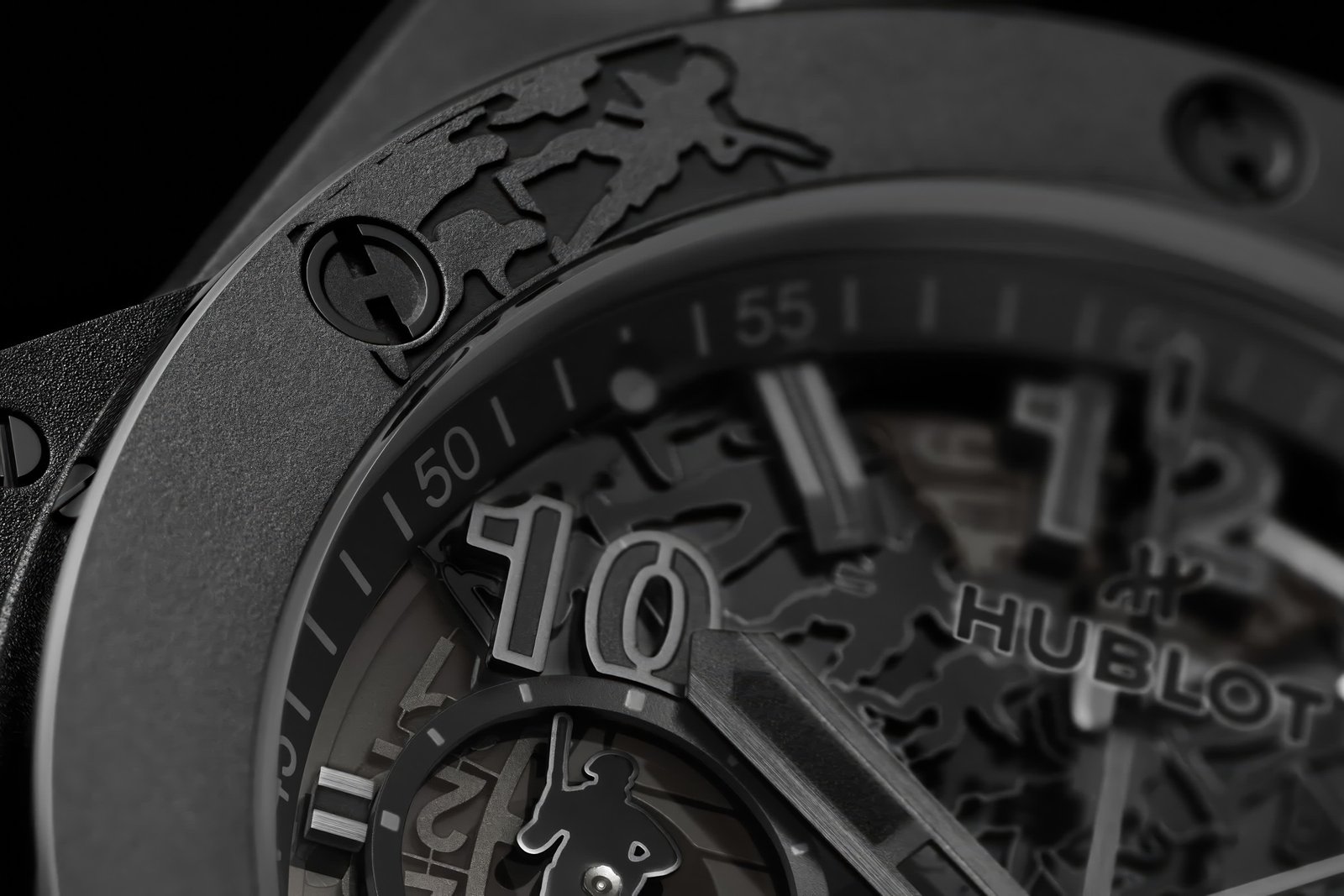
The Hublot Soldier collaboration has released 50 limited-edition timepieces designed in partnership with Soldier, a London-based visual artist, designer, and skateboarder born Leonard Iheagwam. The watches, crafted in black ceramic and black-plated titanium, feature the artist’s signature toy soldiers and cross motifs adorning the dial and bezel of a 42 mm chronograph. Priced from £22,900 (approximately $30,303), according to ARTnews, the pieces mark the Swiss luxury watchmaker’s latest move into artist-driven design after establishing its collaboration program with established names in contemporary art.
The partnership took shape over two years and traces its origin to an unexpected encounter. Soldier attended a Daniel Arsham collaboration preview at Hublot in 2024, bringing with him several paintings in need of exhibition space. Hublot offered him the chance to preview work in their London store on New Bond Street, a gesture that soon evolved into a formal commission. “The collaboration came together really organically,” Soldier explained to ARTnews during a preview at that same London location. “I was invited to the Daniel Arsham collaboration preview in 2024 and at the time I had made a few paintings that needed a space to preview. Hublot let me do it in their London store, which led to them asking me to do create a London watch.”
The Hublot Soldier Collaboration and Its Conceptual Framework
The toy soldiers and crosses that dominate Soldier’s visual language are deeply rooted in his personal history. Born in Nigeria, he wore camouflage clothing while skateboarding as a teenager, a choice that invited confrontation with police and military authorities in a country where civilian camouflage wear was prohibited due to civil war. The cross imagery carries separate significance, referencing his father, who works as a reverend. These symbols first appeared in Soldier’s painting practice in 2024 through a partnership with gallerist Angelica Mara Jopling at Incubator, establishing the motifs that would eventually transfer to wrist.
When designing the watch, Soldier approached the object with the same conceptual framework he brings to painting. He invoked Marcel Duchamp’s readymade strategy, positioning the finished watch as an existing form awaiting artistic intervention. “A watch is already an object, which has thought behind it, and so the process is quite simple,” he said. Before finalizing the designs, Soldier traveled to Hublot’s Swiss headquarters to observe the watchmaking process firsthand, witnessing how engineers construct each piece with precision rather than industrial mass production. The experience shifted his understanding of watches as handcrafted luxury objects. “Art and watches are not mass-produced items,” Soldier reflected. “There are actual engineers who work on creating such a piece.” He now wears his own Hublot engraved with the phrase “artist proof.”
A Three-Year Trajectory in Visual Art
Soldier’s ascent into the international art world has been compressed into an unusually brief timeline. He relocated to England in 2019 and only began formally exhibiting his work three years ago. His gallery representation through Jopling led to a solo show titled “When The Saints Go Marching,” which featured paintings that drew from both war-era memories and family portraiture, layering personal and national history. The work caught the attention of figures in the contemporary art sphere including Charlie Gosling, Lorenzo Amos, and Robert Nava, who have become collaborators and peers.
Looking forward, Soldier is preparing what he describes as a “very important” solo exhibition scheduled for 2028 at an institution he declined to name publicly. He positioned the upcoming show as significant within the broader Nigerian creative landscape, where he observes that visual art has not achieved the same international momentum as the country’s fashion industry, citing Lagos Fashion Week as a point of comparison. “I didn’t grow up thinking I could be a painter, neither could my parents,” Soldier told ARTnews. “I’ve only been showing work for the past three years.” That trajectory from skateboarding teenager in Nigeria to designer collaborating with Swiss watchmakers in London in just a handful of years underscores how quickly artists can move through institutional networks once their work gains traction.