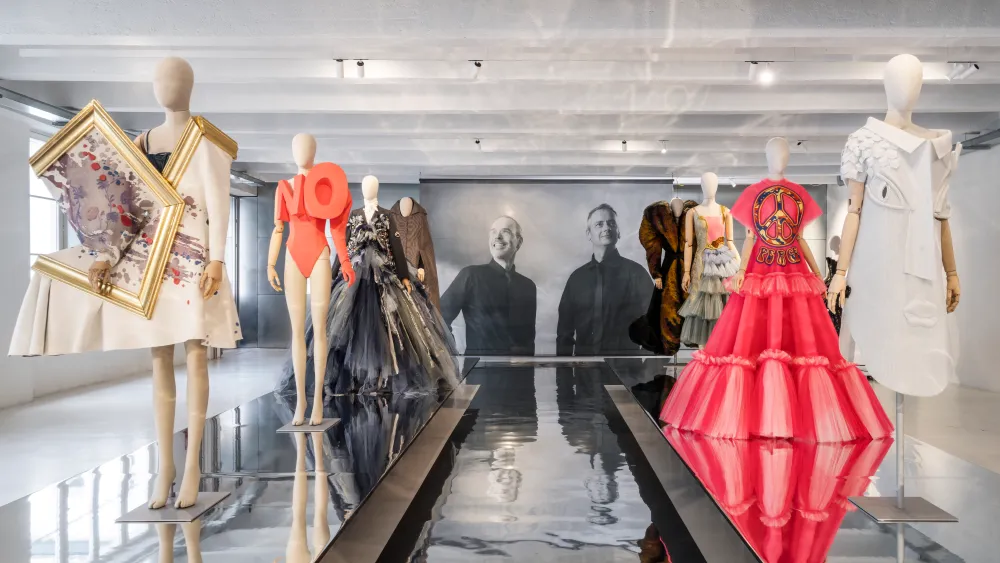
Viktor&Rolf Exhibition: The Dutch design duo’s first museum show proves that fashion can be as conceptually uncompromising as fine art.
When Viktor Horsting and Rolf Snoeren began making clothes together in the early 1990s, the fashion industry was still operating on a fairly rigid contract: a designer’s job was to create garments that fit bodies, flattered silhouettes, and sold. The Viktor&Rolf duo had other ideas. They wanted to make clothes that asked questions instead of answering them, that challenged the very idea of what a garment could be. Three decades later, that impulse hasn’t dulled. It’s only grown stranger, sharper, and more necessary.
This November, Viktor&Rolf arrives at 10 Corso Como Milan as “Spectrum,” an exhibition that gathers 20 haute couture looks spanning their entire career. The show is not framed as a retrospective in the conventional sense. There are no polite timeline markers, no “early period” or “maturation” narratives. Instead, the curation centers on a single obsession: how clothing functions as a tool for artistic expression and conceptual thinking, divorced entirely from commercial necessity or seasonal trends.
The Viktor&Rolf Spectrum Exhibition Reframes Fashion as Conceptual Art
The curatorial logic here is what distinguishes “Spectrum” from the standard designer monograph. According to Milan Fashion Campus, the exhibition explores “the relationship between clothing, artistic expression and conceptual design,” positioning each piece not as a wearable object but as an argument. This is what separates Viktor&Rolf from most of their contemporaries, even the ones with similar ambitions. They have never been interested in making clothes that simply look expensive or innovative. They are interested in making clothes that change how you think about the human body, fabric, symmetry, and decoration.
The scale of the selection matters. Twenty pieces across thirty years is not a comprehensive survey. It is a carefully chosen syllabus, a master class in how to use textiles and structure to say something that cannot be said any other way. Each garment in the show presumably represents a moment when the designers rejected a conventional solution in favor of something stranger. That resistance, sustained across three decades, is what the show appears to be documenting.
The timing of the exhibition also signals something worth noting. Milan Fashion Campus describes this as a moment when the city offers opportunities “to discover fashion beyond the runway,” suggesting that gallery presentations have become a necessary counterweight to the fashion calendar’s relentless cycle. By moving into a museum context, Viktor&Rolf’s work gets reframed. It stops being about next season and starts being about artistic legacy. The clothes become artifacts of a philosophical position, not commodities waiting to be purchased or copied.
The Politics of Silhouette and Proportion
What makes this show particularly relevant right now is that fashion has spent the last decade becoming increasingly literalist. Designers have defaulted to heritage narratives, archival references, and retro recycling. Viktor&Rolf have done the opposite. They have treated the human silhouette as an ongoing problem to be solved, reshaped, and interrogated. Their approach assumes that you can challenge beauty standards, gender presentation, and the idea of “flattering” entirely through how you cut and proportion fabric.
The exhibition’s title, “Spectrum,” hints at this range. Rather than suggesting a single coherent vision, it implies prismatic refraction, the idea that one philosophical position can produce multiple, sometimes contradictory outcomes. This is very much in line with how Viktor&Rolf actually work: they are not designers who have a signature silhouette they refine over time. They are designers who start with a constraint or a question and see where the garment takes them.
For anyone paying attention to what contemporary fashion is capable of becoming, the Viktor&Rolf exhibition is essential viewing. It demonstrates that there is still space for designers to operate outside the influencer cycle, the brand expansion machinery, and the seasonal treadmill that dominates contemporary fashion discourse.
Sources: milanfashioncampus.eu