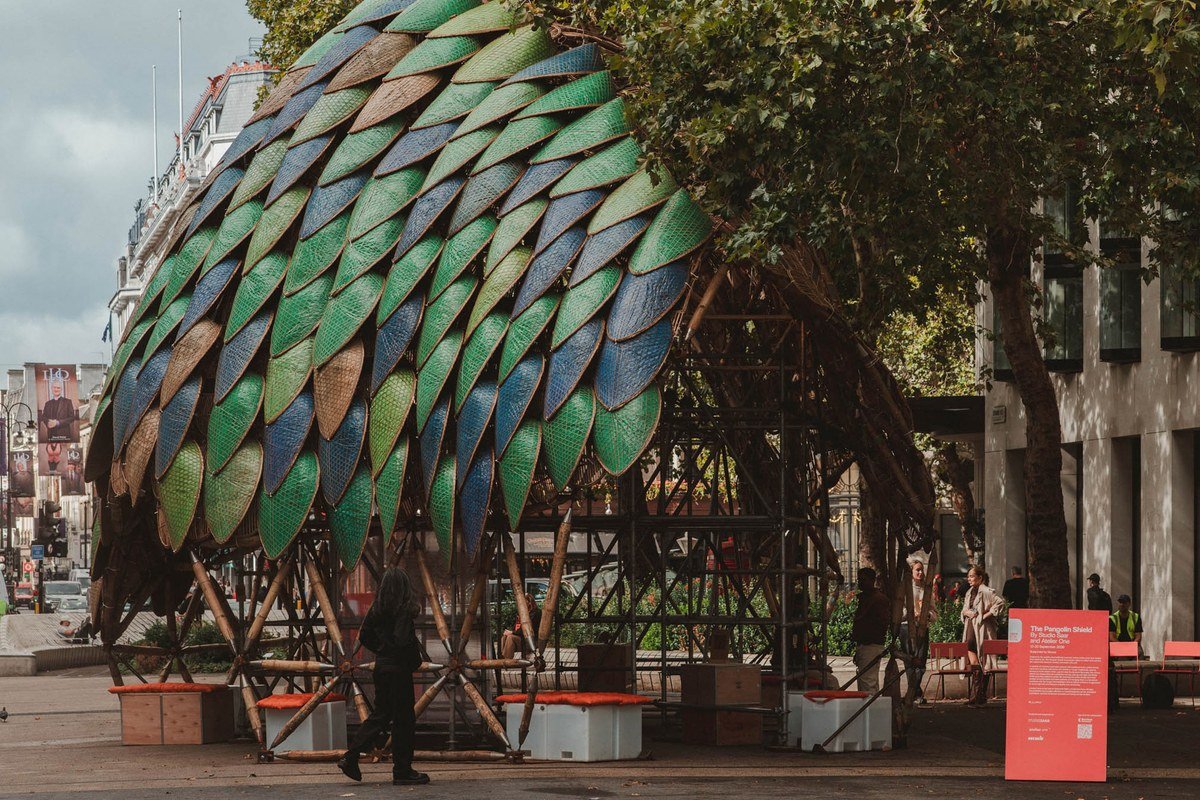
Pangolin Shield Pavilion: A bamboo structure crowned with police riot shields became the festival’s unlikely centerpiece, sparking debate about art, protest, and who gets to reclaim symbols of state power.
The Pangolin Shield Pavilion arrived at London Design Festival like a provocation wrapped in sustainable materials. Built from bamboo and topped with a literal crown of police riot shields, the installation commandeered attention and social feeds in ways that polished furniture drops and minimalist lighting sculptures simply could not. It was the kind of piece that made people stop mid-stride on the Strand, phones out, wrestling with what they were actually looking at and why it unsettled them.
The Pangolin Shield Pavilion’s Confrontational Design Argument
The genius of the Pangolin Shield Pavilion sat in its refusal to choose a lane. Structurally, it was pure design thinking: bamboo has become the darling of sustainable architecture, a material that performs well and photographs beautifully. That foundation alone would have made it noteworthy. But the designer made a choice that transformed it from elegant to electric. Those shields, the objects deployed against protesters and rioters, became ornamentation. They became a crown. The pavilion essentially asked passersby to think about whose symbols get neutralized, aestheticized, and repositioned as art objects.
This wasn’t subtle, and it wasn’t supposed to be. London Design Festival typically trades in refinement and accessibility, spaces where design democratizes taste and makes luxury feel inevitable. The Pangolin Shield Pavilion violated that contract. It imported political discourse directly into a festival celebrated for its visual calm. Visitors split visibly: some saw brilliant critique of state apparatus and police overreach, repackaged as something that belonged in a design conversation. Others saw antagonism masquerading as innovation, or worse, appropriation of genuine street conflict as aesthetic material. Neither reading was wrong, which was exactly the point.
What made the installation’s dominance genuinely significant was that it arrived during a moment when design institutions are increasingly expected to take positions. The piece couldn’t be dismissed as a stunt or a joke. The structural integrity was there. The material choice was defensible. The political content was intentional but not didactic. It forced the festival itself into a position it rarely occupies: genuinely uncomfortable, forced to defend why this belonged among chair designs and spatial experiments. Whether you found it essential provocation or unnecessary noise, the Pangolin Shield Pavilion did something design rarely manages anymore. It made people argue about what design is actually for.