Milano Jewelry Week 2026: From October 20 to 26, over 400 designers descend on Milan’s historic palaces to redefine what jewelry can be.
Milan has always been a stage for ambition, Fashion Week, the Salone del Mobile, the galleries of Brera, the grand palazzi that line its streets. So it follows that the city would become home to Milano Jewelry Week 2026, one of contemporary jewelry’s most vital gatherings. This October, the event returns for a week-long takeover that treats the entire city as a single, sprawling exhibition space rather than confining creativity to any single venue.
From October 20 to 26, 2026, more than 400 designers, schools, galleries and industry professionals from dozens of countries will present work across historic buildings, galleries, ateliers, boutiques and cultural spaces throughout Milan. The scale is significant, but the real power of the event lies elsewhere, in a fundamental shift in how contemporary jewelry thinks about itself. These aren’t precious objects designed to disappear into a safe. They’re ideas made small, proposals for what the body can wear and what materials can mean.
Milano Jewelry Week 2026 Across Historic Venues
Walk through the current iteration and you’ll see geometric silver bracelets that function as architectural statements, minimal sculptures where form overtakes function entirely. Brooches become free-standing works that happen to pin to clothing. The proportions are rigorous, the lines clean, the kind of design that would feel equally at home in a contemporary art gallery as on a lapel. This isn’t maximalism or the maximalist’s cousin. It’s the opposite. Aesthetics here emerge from restraint, from the power of a single idea pursued without apology.
Elsewhere, designers have abandoned the pursuit of perfection altogether. Rough amethysts, amber, chrysocolla and other striking stones appear exactly as nature made them, their original character preserved rather than forced into symmetry. The composition builds around the stone itself, with designers highlighting variations in color, texture and the small imperfections that separate handmade work from industrial product. It’s an approach that rejects the flawless uniformity that defined luxury jewelry for decades, returning instead to something older and more honest: authenticity.
Beyond Jewelry Into Sculpture
Some pieces abandon the category altogether. A ring becomes a sculpted elephant’s head. A necklace resembles an organism growing across the body. Others evoke botanical forms or underwater worlds. The human body becomes a canvas for miniature sculptural composition, and technical mastery serves narrative rather than the reverse. These creations would look unremarkable in a contemporary art museum. The fact that they’re called jewelry almost seems incidental.
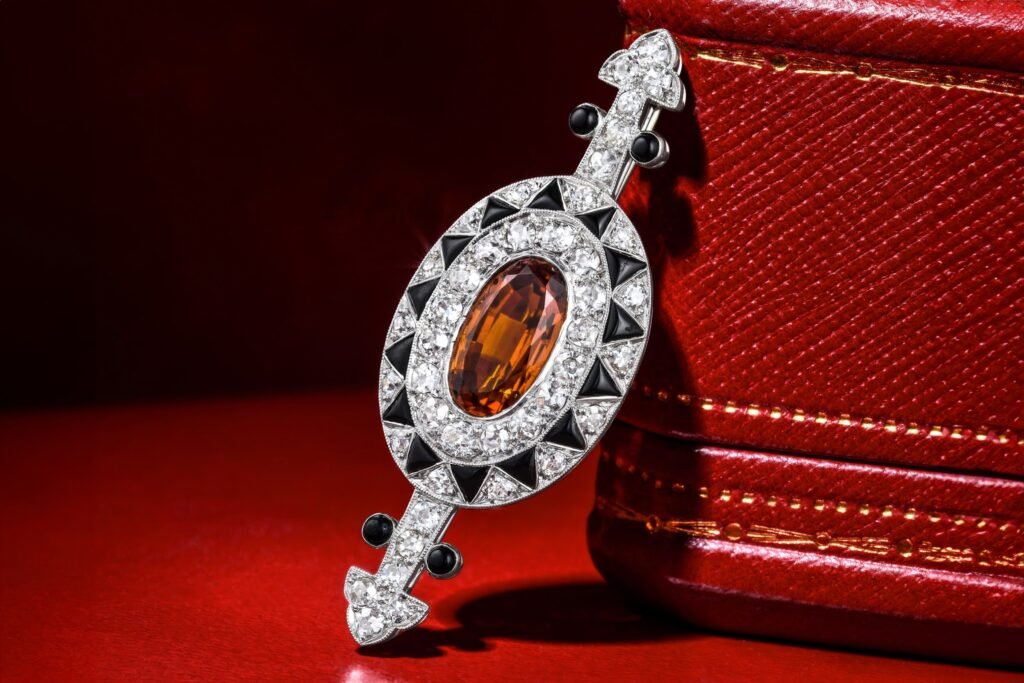
This experimentation doesn’t exist in a vacuum. Alongside the boundary-pushing work runs a parallel current of high jewelry featuring diamonds and colored gemstones, pieces that demonstrate intricate stone-setting techniques and prove that tradition can evolve without losing its soul. The result is a creative dialogue, not a culture war. Luxury is no longer defined by materials alone but by imagination, by the willingness to ask what jewelry could be rather than accept what it has always been.
The City as Exhibition
The physical geography matters here. Historic venues like Palazzo Bovara and Palazzo Serbelloni open their doors, their marble staircases, frescoes and grand rooms becoming backdrops for contemporary work. The contrast between centuries-old architecture and avant-garde design creates friction, an atmosphere that a conventional exhibition center could never reproduce. When a piece of jewelry hangs against a fresco or sits on a historic table, it becomes part of a conversation that stretches back centuries while pointing somewhere entirely new.
Milano Jewelry Week succeeds because it understands that jewelry doesn’t exist in isolation. It lives in cities, in history, in the spaces where people move and gather. By distributing the event across Milan rather than containing it, the organizers have created something closer to a cultural movement than a trade show. For one week, jewelry stops being something you buy and becomes something you encounter, something that speaks to how we think about craft, luxury and the small objects that travel closest to our skin.