Watch Auction: In Geneva’s most stunning auction weekend ever, three houses smashed $203 million in 72 hours, with one independent watchmaker’s creations alone accounting for a third of a single sale.
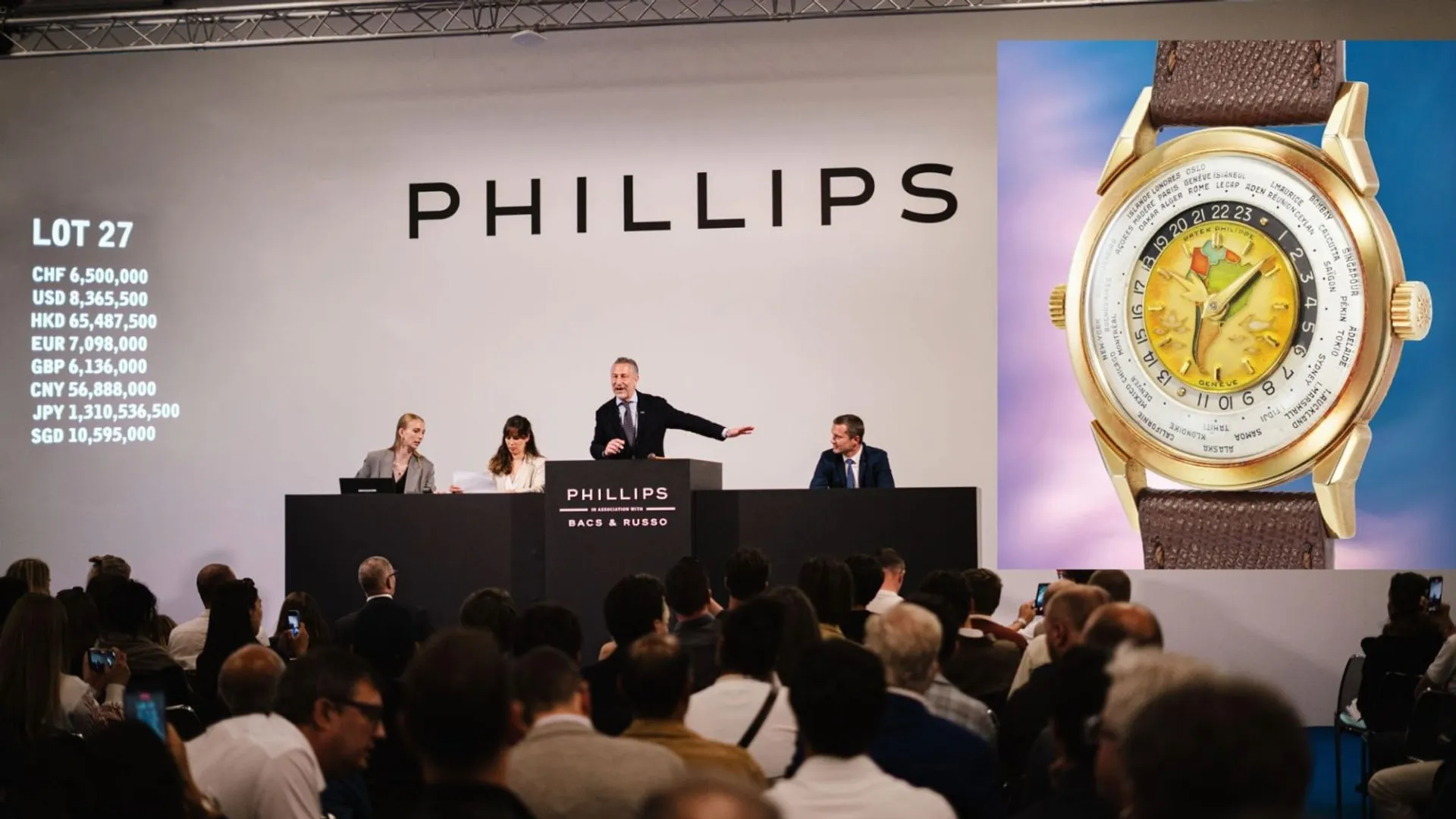
On November 7 and 8, Phillips held a historic watch auction that crossed the $100 million threshold for the first time ever. The Geneva Watch Auction: XXIV, conducted in partnership with Bacs & Russo, generated 92,045,568 Swiss francs, or approximately $112.3 million, according to italianwatchspotter.com. Every single one of 217 lots found a buyer. The 100 percent sell-through rate, paired with the historic total, reset what’s possible in a single night of timed watches hitting the block.
But the November auctions weren’t a one-house story. Christie’s followed on November 9 with its best single-watch auction result in company history, totaling 47,824,592 Swiss francs ($58.7 million). Sotheby’s added another $32 million-plus to the mix. Combined, the three auction houses moved $203 million in watches across one weekend, a figure that captures the scale and intensity of the international collecting market right now. Phillips set 24 world records during its sale. Of the 2,121 registered bidders who participated, they came from 69 countries. Seventeen lots sold for over 1 million Swiss francs each. These aren’t just numbers; they’re evidence of a market that has compressed its passion and its capital into a handful of specific pieces.
The Watch Auction Market Compressed Into Specific Pieces
The most arresting detail buried in these results has nothing to do with Rolex or Patek Philippe. During the Phillips auction, just 13 watches from independent watchmaker F.P. Journe (François-Paul Journe) generated 31.8 million Swiss francs, approximately $38.8 million. That means fewer than 6 percent of the lots offered accounted for roughly 34.6 percent of the total sale. In other words, Journe’s pieces alone nearly eclipsed every other lot combined. The market wasn’t just interested in these watches; it was willing to reorganize entire proportions of its spending around them.
The centrepiece was Lot 7: a Chronomètre à Résonance “Régence” in platinum, which sold for 8,680,500 Swiss francs, equivalent to $10.6 million. This watch embodies Journe’s core technical obsession with resonance, a principle fundamental to his research into movement behavior. The caliber comes from Journe’s first generation of movements, hand-finished with brass plates and bridges, the kind of material choice that signals restraint and intentionality rather than maximum luxury. It’s not about the metal’s weight on your wrist; it’s about what the designer chose to put inside.
Two other Journe pieces underscored this collector preference. The Chronomètre à Résonance Tokyo Boutique sold for 6,146,000 francs. The diamond-set Vagabondage III reached 5,057,000 francs. Together with the Régence, these three watches represent what’s happening across the high-end watch market right now: collectors are willing to pay extraordinary sums for pieces with documented provenance, extreme rarity, and some connection to a watchmaker’s singular vision. Journe’s work satisfies all three criteria, but it’s the vision part that seems to be driving the premiums.
The Selective Collector Emerges
According to italianwatchspotter.com, these Geneva results reflect an increasingly selective approach to collecting. Bidders aren’t chasing volume or broad-based brand investment. They’re competing aggressively for pieces that matter, pieces with historical weight or technical innovation or aesthetic courage. The fact that Phillips achieved a 100 percent sell-through rate across 217 lots doesn’t mean everything was equally desirable; it means the house curated the catalog with enough precision that every piece found its buyer at the right price. That’s different from a hot market where anything moves. That’s a mature, educated market.
The auction results paint a picture of a parallel luxury economy, one in which a single platinum watch movement can trade hands for over $10 million, where a boutique-exclusive model might cross $6 million, and where aesthetic or technical choices matter more than brand name recognition. Journe doesn’t make 10,000 watches a year. He doesn’t have celebrity endorsers or marketing campaigns in prime-time television. His reach is about as far from mass appeal as luxury gets. Yet his pieces commanded roughly one-third of a $112 million auction. That’s not hype. That’s conviction.
The Geneva weekend of November 7, 8, and 9 will likely stand as a moment when the institutional watch market reached a new scale while simultaneously narrowing its focus. Bidders from 69 countries showed up, but they showed up for specific things. Phillips moved more money than any single watch auction in history. F.P. Journe’s 13 pieces proved that independent watchmakers who have spent decades refining a single idea can command prices that rival Patek Philippe. And every lot, across three auction houses, found a buyer. In a luxury market often fractured by trend and noise, these numbers suggest something older and more durable: the enduring power of scarcity, craft, and unwavering vision.