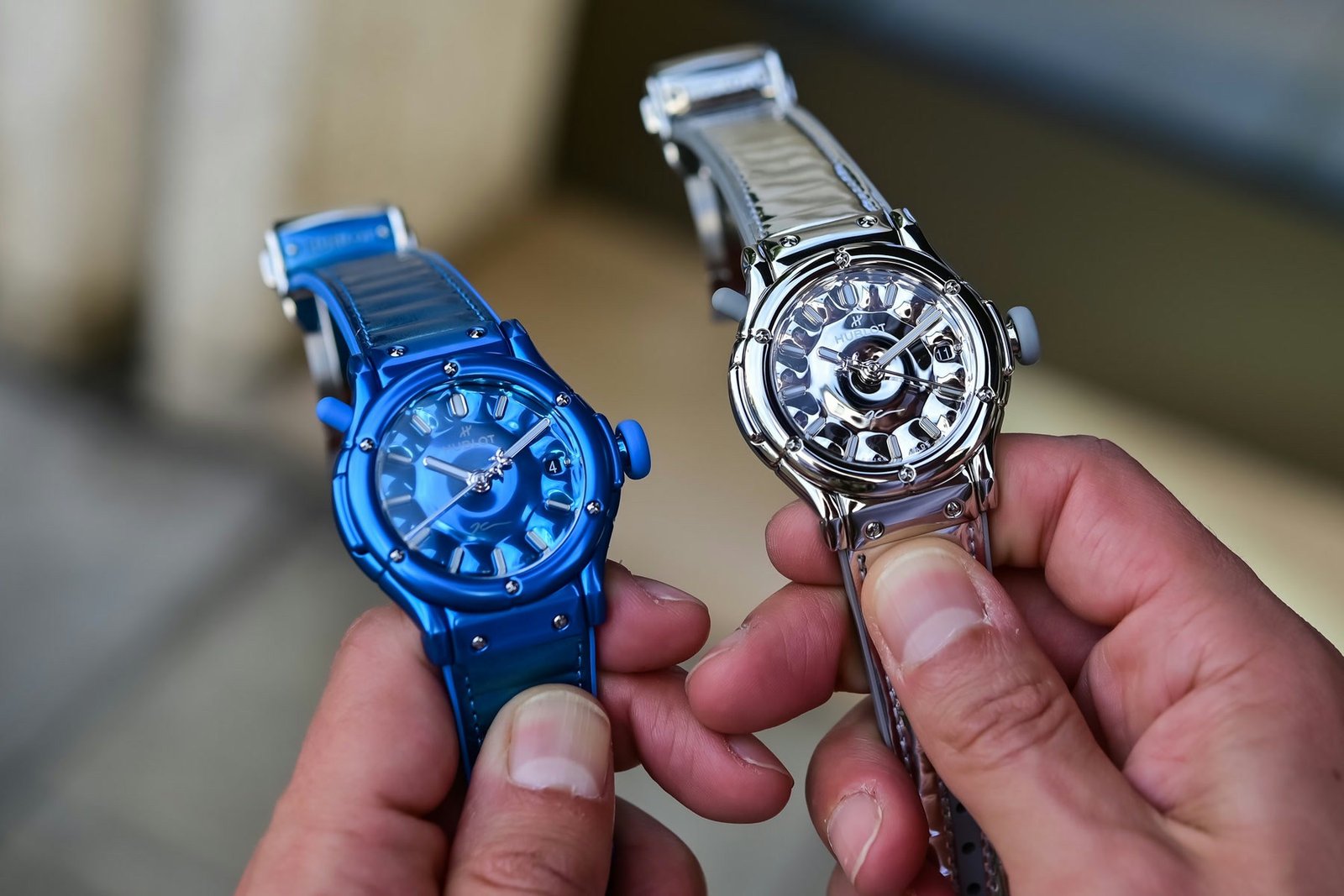
Hublot Jeff Koons Balloon Dog: The luxury watchmaker translates Koons’ mirrored sculpture into a 42mm steel-and-aluminum wrist object, proving that artistic collaboration remains Hublot’s sharpest move.
The Hublot Jeff Koons Balloon Dog watch represents a bold fusion that Swiss watchmaking rarely attempts. While most manufacturers spend decades perfecting incremental refinements to the same basic blueprint, Hublot built its reputation on a willingness to blur the line between horology and high art. So it makes a certain kind of sense that when the watchmaker decided to collaborate with Jeff Koons, the result wasn’t a subtle homage or a tasteful reinterpretation. It was a full translation of one of contemporary art’s most recognizable objects directly onto the wrist.
The Classic Fusion Balloon Dog watch represents Hublot’s latest assertion that watchmaking doesn’t have to live in a hermetically sealed world of traditional complications and conservative aesthetics. According to coverage from LVMH Watch Week 2026 in Milan, the collaboration sits alongside Hublot’s other partnership releases this year, each demonstrating what the brand calls its “Art of Fusion” philosophy. But this one lands differently. This isn’t a tribute watch to an athlete or a designer collaboration that smooths out rough edges for commercial appeal. This is Koons’ mirrored sculpture, reduced to 42mm and rendered in steel and aluminum, stripped down to its essential formal logic.
The watch exists in a limited edition of exactly 200 pieces, according to reporting from Daman. That scarcity is intentional. Koons’ original balloon dog sculptures, often selling for eight figures at auction, exist in a rarefied collector realm. A 200-piece watch doesn’t democratize that work so much as it creates a new category of access, one that sits somewhere between replica and artifact. The watch becomes a wearable gesture toward the sculpture rather than a faithful reproduction. And in that gesture, something interesting happens: the object becomes its own thing entirely.
The Hublot Jeff Koons Collaboration and Its Material Strategy
What makes this collaboration actually work is the choice of materials. The case is steel and aluminum. Those aren’t glamorous options by traditional luxury watch standards. They’re industrial, utilitarian, slightly deflationary in the face of precious metals. But that’s precisely why they make sense here. Koons’ balloon dogs exist as mirror-finished sculptures that reflect and distort their surroundings. The sculpture is about surface, reflection, and the gap between what appears and what is. Steel and aluminum, with their capacity for high polish and metallic sheens, echo that logic without trying to be precious about it.
The 42mm case size is significant too. It’s large enough to register on the wrist with real presence, but not so oversized that it tips into costume territory. That balance is harder to strike than it sounds. Oversized watches can quickly read as parody when they’re based on iconic art objects. This one walks that line carefully, suggesting the sculpture without performing it.
Hublot’s Art Market Bet
This collaboration sits within a larger strategy that Hublot has been pursuing for years. The brand has increasingly positioned itself not as a traditional luxury house but as an art-adjacent brand that happens to make watches. At LVMH Watch Week 2026, Hublot announced a Novak Djokovic tourbillon that incorporates material from the champion’s actual tennis racquets and Lacoste polo shirts into a composite case. That watch exists in a numbered collection rather than a limited edition, with Hublot committing to produce additional pieces if Djokovic wins more Grand Slams. It’s brand storytelling taken to an almost absurd level of specificity. The Balloon Dog watch operates in similar territory, but through the lens of fine art rather than sports celebrity.
What’s striking about Hublot’s approach across these collaborations is a refusal to treat partnerships as marketing add-ons. The Koons watch isn’t a watch with a Koons-inspired dial. It’s a structural translation of a Koons work into horological form. That’s a fundamentally different undertaking, one that requires real dialogue between the artist’s vision and the watchmaker’s constraints. Whether that dialogue actually happened at the design stage or whether Hublot simply saw an opportunity and ran with it is impossible to know from the outside. But the result reads as genuine, which counts for something in a market increasingly crowded with cynical brand extensions.
At 200 pieces, the watch sits at that perfect scarcity threshold where ownership becomes genuinely exclusive without feeling artificially gated. For comparison, Rolex produces tens of thousands of sports watches per year. A 200-piece run is rarefied enough to maintain collector interest without suggesting the entire project is some kind of limited-edition trap. It’s the kind of number that actually means something to collectors and to the market, rather than the arbitrary caps that brands sometimes impose just to create urgency.
What’s striking about Hublot’s approach across these collaborations is a refusal to treat partnerships as marketing add-ons. The Hublot Jeff Koons Balloon Dog watch isn’t a watch with a Koons-inspired dial. It’s a structural translation of a Koons work into horological form. That’s a fundamentally different undertaking, one that requires real dialogue between the artist and the manufacture, resulting in a wearable sculpture that stands entirely on its own merits.