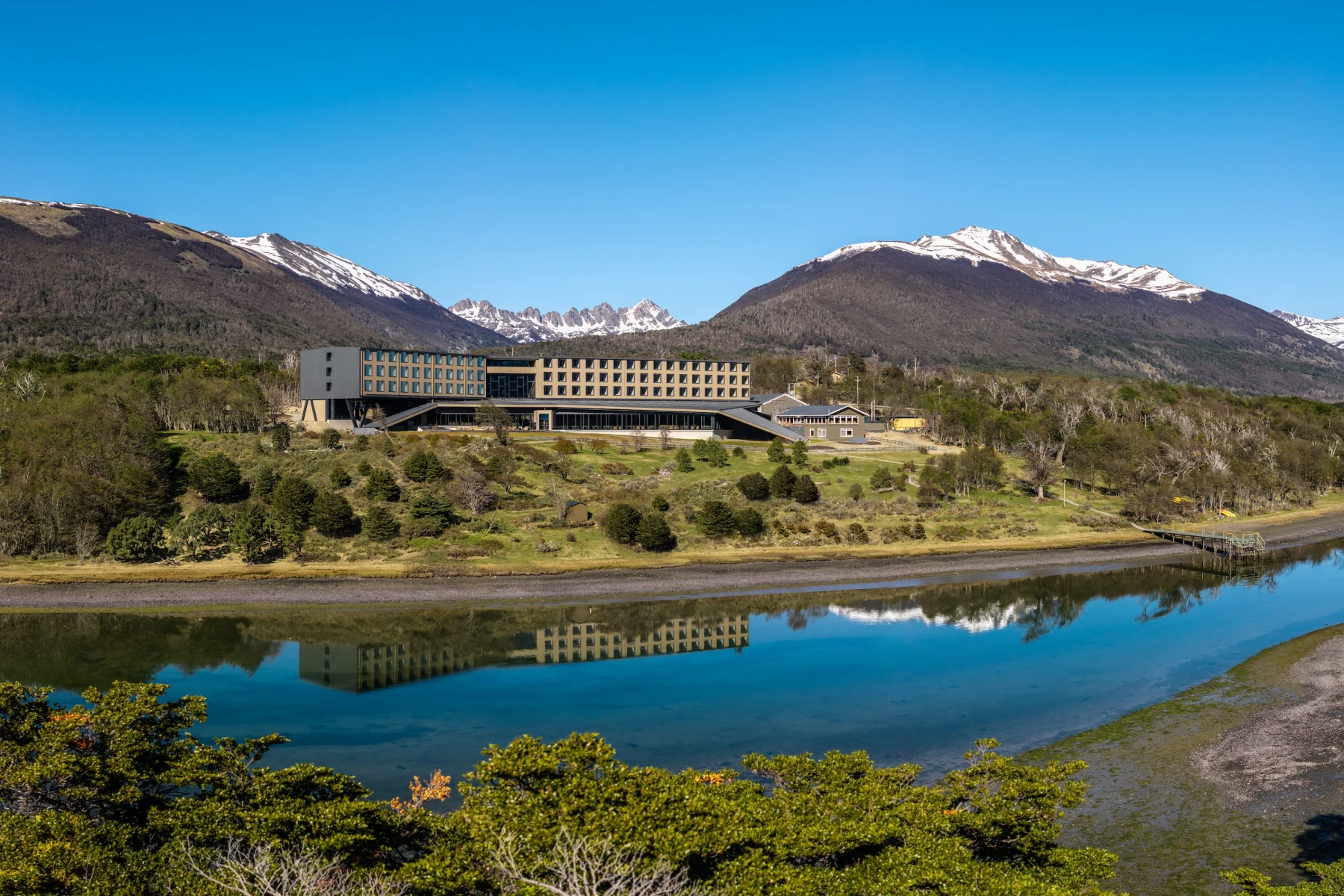
Cormorant At 55 South: Royal Caribbean’s ultra-luxury cruise line just opened a 150-room hotel in Puerto Williams, Chile, eliminating the Drake Passage ordeal for travelers heading to Antarctica.
At the southern tip of South America, where the Beagle Channel cuts between Patagonian mountains and the nearest major city is a three-hour flight away, there is now a hotel designed to make the end of the world feel less remote. The Cormorant at 55 South opened this month in Puerto Williams, Chile, a settlement of roughly 2,000 people, and it represents something the cruise industry has never attempted before: a luxury property built entirely from scratch by an operator to serve its own guests.
The Cormorant at 55 South’s Eight-Year Vision That Changed Antarctica Access
What began as a proposal from Silversea’s Chilean air partner took eight years to materialize. The concept was straightforward but audacious: rather than shuttle guests through multiple hotels with inconsistent standards, build one unified luxury base where travelers could recover from long-haul flights and prepare for the two-hour charter hop to King George Island in Antarctica’s South Shetland Islands. Previously, Silversea’s fly-cruise operation departed from Punta Arenas, with passengers distributed across several properties of varying quality and comfort. Moving the operation farther south to Puerto Williams and housing everyone under one roof changed the equation. Of Silversea’s 40 Antarctica sailings across three ships, 29 are structured as “Fly Cruise” expeditions. That scale justified the investment. The hotel becomes a gateway that lets guests skip the Drake Passage, the notorious stretch of ocean between South America and the Antarctic Peninsula known for severe weather and rough seas that has tormented seafarers for centuries.
The physical construction required unusual logistics. All 150 rooms were built as modular units in Mendoza, Argentina, then transported across the Andes and through Patagonia to reach their final location. Chilean architects, designers, and artists collaborated to solve a central problem: how to deliver a genuinely luxurious experience in one of the world’s most remote commercial zones. The building itself emphasizes transparency and landscape connection, with expansive windows framing the Fuegian Andes and the outlet of the Beagle Channel. Soaring ceilings and materials sourced locally (stone, driftwood, lenga wood from regional forests) reinforce a sense of belonging to place rather than corporate standardization.
What It Looks and Feels Like on Opening Week
Guests arriving at the Cormorant encounter a deliberate image: gauchos on horseback greeting visitors at the entrance, an immediate signal that this hotel occupies a different world. The 150 identical rooms are compact and modular but thoroughly appointed. The bar showcases local stone and driftwood. Some furnishings, including television cabinets in guest rooms, feature local lenga wood. A copper fireplace and plush seating line windows overlooking water and mountains. For those recovering from a three-hour charter flight from Santiago or similar transoceanic routes, the main experience is horizontal: sitting still, looking outward, feeling the landscape.
The activity menu reflects the location rather than typical resort offerings. Included excursions include bird-watching outings (where within minutes visitors encounter endemic red-beaked dolphin gulls, upland geese, and multiple cormorant species), kayaking, and a shuttle into Puerto Williams proper. Horseback riding is available but carries a separate $100-per-person fee. Chilean wine and pisco tastings connect guests to regional culture. These aren’t distractions from the main event (Antarctica); they’re warmup acts for eyes and minds preparing for extreme landscape.
A Windfall for a Forgotten Town
Puerto Williams, population 2,000, sits among the most isolated inhabited areas on Earth. The hotel brings reliable employment and visitor spending to a community that existed largely outside commercial tourism. The investment represented not just a business decision but an infrastructure commitment to a place most of the world will never visit. Silversea and its partners chose to anchor their Antarctica operation here rather than in a larger city, which redistributes tourism economics to the margins rather than concentrating it in already-developed zones.
That choice also shapes the guest experience in an unexpected way. Because Puerto Williams has no mass tourism infrastructure, no competing restaurants or shops, no commercial noise, the hotel becomes genuinely disconnected from the typical luxury hospitality environment. Guests cannot distract themselves shopping or bar-hopping. They face the landscape, the animals, the light, the silence. The two-hour charter flight to Antarctica becomes less a leap into an alien realm and more a continuation of a journey that started the moment they arrived at this modest southern outpost.
Sources: afar.com