Patek Philippe Watch Art Milan: The seventh edition of WATCH ART opens in Italy’s largest venue yet, showcasing 500 pieces across 2,900 square meters of meticulously staged Geneva nostalgia and Italian-themed haute horlogerie.
When Patek Philippe decided to bring its peripatetic WATCH ART Grand Exhibition to Milan, it didn’t just rent space. It took over CityOval, the restored Palazzo delle Scintille in the CityLife district, a 30-meter-high domed building that transforms into a seven-room shrine to Swiss watchmaking precision. The exhibition opened with over 500 watches, movements, and objects spread across approximately 2,900 square meters, marking the largest and most architecturally ambitious iteration of a show that has previously landed in Dubai, Munich, London, New York, Singapore, and Tokyo. This is the first time Italy hosts the Patek Philippe WATCH ART exhibition, and the scale alone signals something important: Patek Philippe is no longer simply rotating a collection. It’s building an experience.
The curatorial strategy feels deliberate, almost cinematic. Rather than the sterile grid of a typical trade show, WATCH ART orchestrates the journey through reconstructed environments that collapse the distance between Geneva’s streets and the manufacture’s inner world. A nine-meter-high, 4.5-meter-wide sculpture composed of more than 2,000 translucent droplets pays homage to Geneva’s Jet d’Eau, anchoring the entire narrative to Switzerland’s most recognizable symbol. This isn’t subtlety. It’s immersion. As visitors move through different rooms, they transition from the current collection toward historical pieces, technical subjects, and decorative crafts. The layout refuses the reductive logic of display cases. Instead, it creates a conversation between geography, time, and technique.
Patek Philippe WATCH ART: Where Complexity Meets Craft
The current collection occupies a central gallery organized around the brand’s core families and complications: Calatrava, Nautilus, Aquanaut, perpetual calendars, chronographs, minute repeaters. Seeing them together exposes the full spectrum of Patek Philippe’s approach to watchmaking across radically different levels of complexity. But here’s where Milan’s edition distinguishes itself from prior exhibitions. The display strategy doesn’t fetishize mechanical construction. Instead, it foregrounds the decorative and artisanal techniques that separate exceptional pieces from merely technically sound ones: miniature painting on enamel, cloisonné enamel work, hand engraving, micro-wood marquetry, hand-executed guilloché, and gem-setting. Around 25 watches, pocket watches, and clocks featuring Italian themes are presented in their own section, a curatorial choice that transforms the exhibition from a universal retrospective into something locally rooted.
What elevates this beyond museum aesthetics is the presence of artisans working in real time in front of visitors. Watching a craftsperson apply enamel to a dial or execute guilloché on a movement component makes the labor audible and visible. It’s the difference between reading about hand-finishing and understanding, through observation, why a Patek Philippe costs what it costs. The Italian setting sharpens this point. Milan knows luxury, knows craft, knows the distinction between industrial production and bespoke artisanal work. The exhibition doesn’t need to explain itself to this audience. It just needs to show.
Behind the Dial: Production and Precision
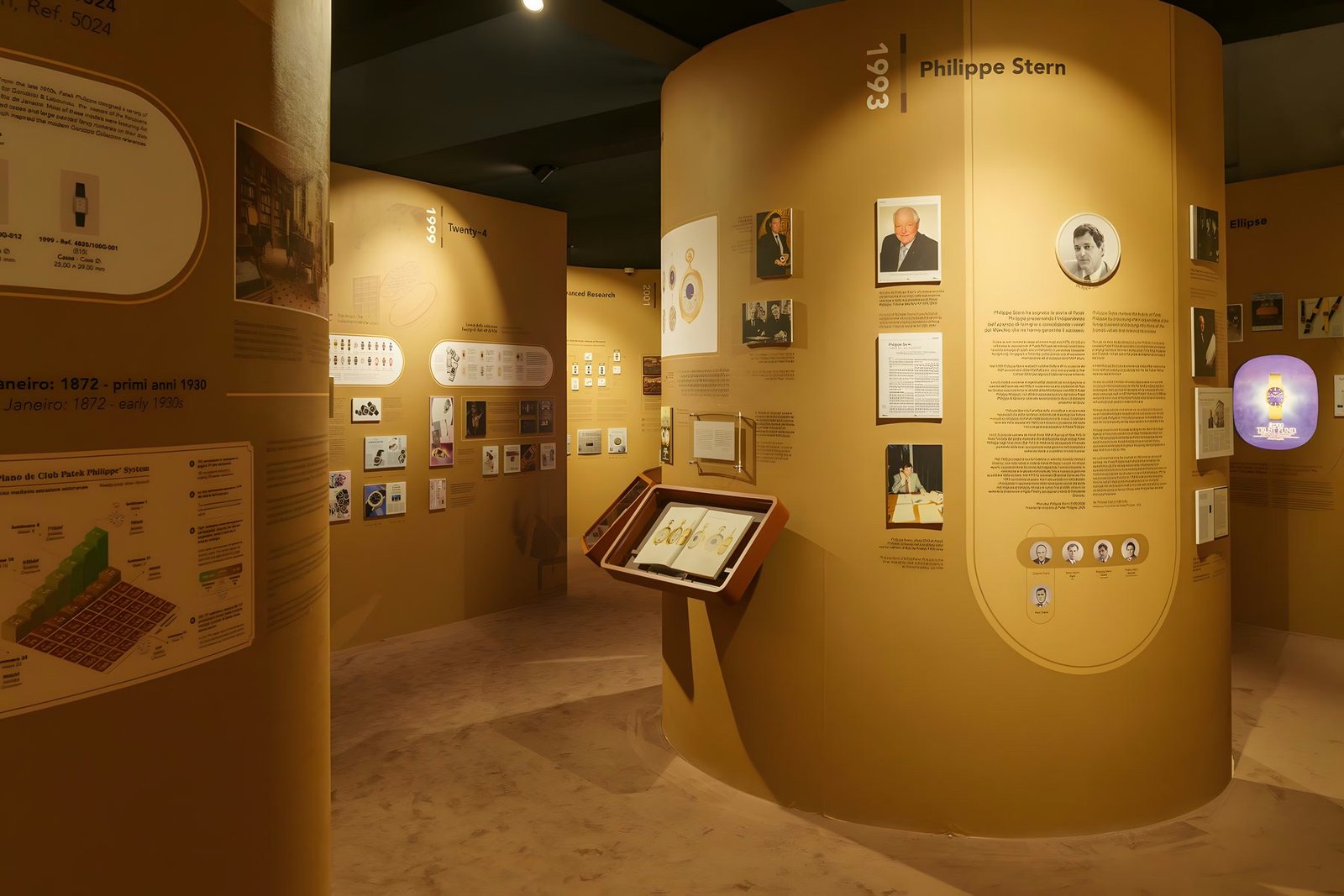
Another section pulls back the curtain on manufacture operations entirely. Movements are displayed alongside detailed explanations of production stages and component finishing. Dedicated zones devoted to research and development offer glimpses into the technical infrastructure that underpins Patek Philippe’s claim to horological authority. This is where the exhibition becomes educational without feeling didactic. The company isn’t lecturing visitors on watchmaking principles. It’s presenting the evidence of its own obsession with precision, allowing the work to speak for itself.
The exhibition spans what amounts to a vertical history of Patek Philippe’s output: contemporary pieces adjacent to historical references, technical subjects positioned alongside decorative crafts. The scale of 2,900 square meters means nothing gets crowded. Nothing competes for attention. Each section breathes. Each transition feels earned rather than rushed. For a brand built on the premise that a watch is simultaneously a wearable instrument and a portable work of art, the Milan edition finally gives both claims their due. Geneva’s geographic and cultural imprint runs throughout, but Milan’s presence isn’t ignored. The Italian-themed pieces ensure the exhibition speaks to the city’s sensibilities and history without erasing its Swiss foundation.
The exhibition spans what amounts to a vertical history of Patek Philippe’s output: contemporary pieces adjacent to historical references, technical subjects positioned alongside decorative mastery. By anchoring the Patek Philippe WATCH ART experience in Milan’s design literacy and Italian craftsmanship tradition, the brand has created something beyond a rotating collection. It’s a fully realized statement about why precision, artisanal technique, and cultural context matter in contemporary luxury.