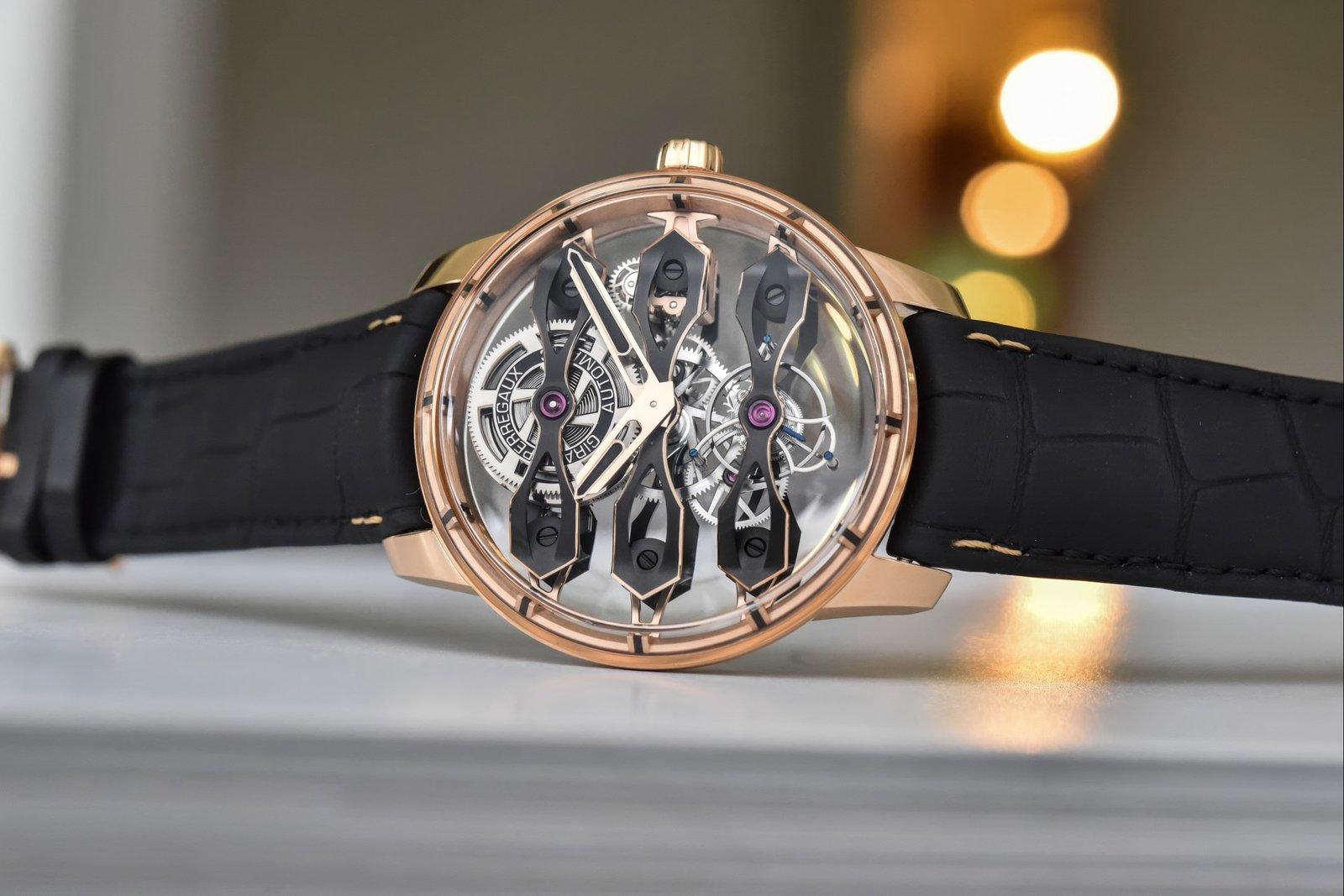
Girard-Perregaux Three Bridges: The Geneva watchmaker’s Laureato Three Gold Bridges introduces warm metal to an architectural blueprint first established in 1867.
Girard-Perregaux has reinterpreted one of watchmaking’s most recognizable mechanical signatures by introducing rose gold to the Three Bridges configuration that has defined the manufacture since 1867. The new Laureato Three Gold Bridges places three rose gold bridges within the movement, each featuring arrow-shaped contours with polished bevels and satin-finished surfaces that draw the eye directly to the gear train visible beneath the dial.
The decision to work in rose gold represents a material shift for the architecture. Where previous iterations relied on steel or other metals, the warmer tone adds visual softness to the geometric precision of the bridge design. The bridges frame the movement’s barrel, gear train, and tourbillon arrangement, while a platinum micro-rotor and lyre-shaped titanium tourbillon cage complete the mechanism. The 41mm steel case measures 10.85mm thick and is framed by a white gold octagonal bezel that contrasts with the rose gold bridges visible through the caseback.
Girard-Perregaux Three Bridges Movement in Rose Gold
The watch runs on Girard-Perregaux’s GP9620 calibre, an extensively skeletonised construction that exposes the mechanical hierarchy of the movement. The finishing work involved 418 hand-polished angles, including 362 inward angles, according to DesignScene. A single watchmaker oversees the assembly and signs the movement, embedding individual accountability into each piece. The power reserve stretches to 55 hours, a specification that reflects the efficiency of the movement’s architecture.
The Three Bridges configuration itself carries historical weight. First established in 1867, the design has become a Girard-Perregaux signature, appearing across multiple collections and serving as the foundation for the manufacture’s technical identity. By introducing rose gold as the primary bridge material, the Laureato Three Gold Bridges offers collectors a warmer aesthetic interpretation of a design that typically emphasized steel’s neutral precision.
The Laureato Context
The Laureato collection has long been Girard-Perregaux’s bridge between classical watchmaking and contemporary design sensibilities. The octagonal bezel, borrowed from the model’s original 1970s sports watch lineage, frames the rose gold bridges in a way that emphasizes both structural and aesthetic balance. The white gold bezel provides visual separation from the rose gold movement components, creating depth when viewing the watch from the side or through the caseback.
This release arrives as part of a broader moment in luxury watchmaking where maisons are reconsidering material palettes and warm tones. Rose gold, in particular, has shifted from being positioned as an alternative metal to becoming a primary material choice for technically sophisticated pieces. For Girard-Perregaux, adding rose gold to the Three Bridges design suggests the manufacture views the material not as a stylistic accessory but as integral to how this iconic architectural element can be perceived and appreciated by collectors worldwide.