Dubai Design Week: As the 12th edition wraps November 8, the festival’s most striking works are mining regional craft traditions and rethinking what architecture can do to the body and mind.
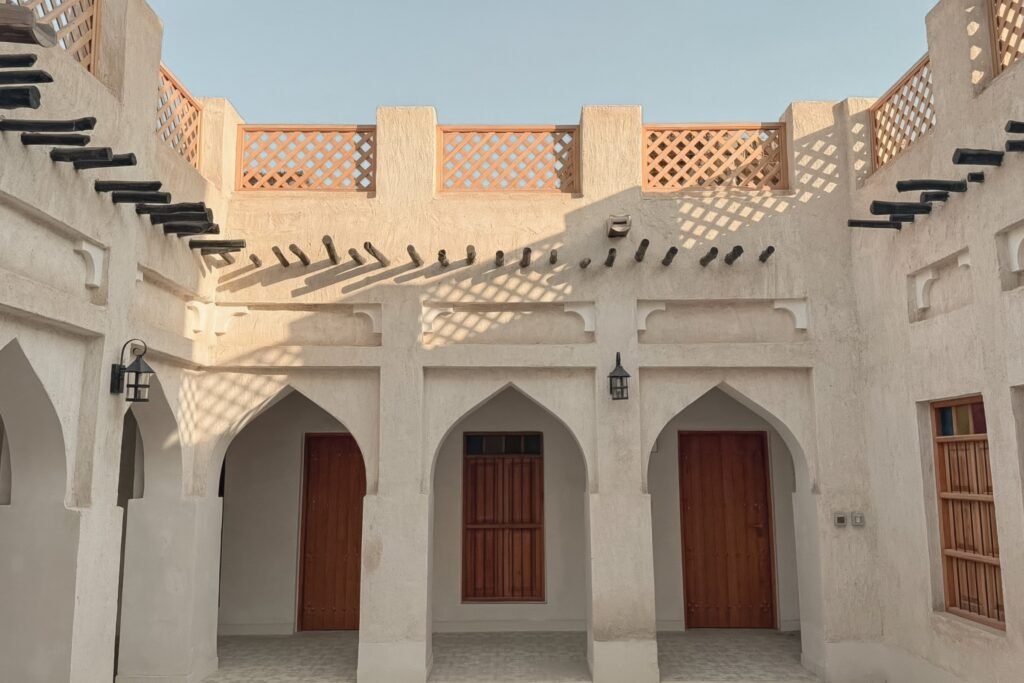
Walk into Three Gardens and a Room at the center of Dubai Design District and you leave the glass and steel behind during Dubai Design Week. Pink, ochre, and yellow curved walls frame desert trees, sidr and samr branches creating shade overhead, gravel paths crackling underfoot. It’s a deliberate collision: hyper-designed sequestration rising inside one of the world’s most aggressively commercial zones. The installation, developed by Dubai-based NAO Architects and this year’s winner of Dubai Design Week’s Urban Commissions award, makes its argument through precision, not rhetoric. Every material choice is a move.
The piece works from Gottfried Semper’s 19th-century Four Elements of Architecture, translating his roof, hearth, mound, and enclosure into something local and tactile. A yellow circular structure holds a grassy mound planted with desert acacias. An ochre enclosure functions as a seating hearth beneath sidr shade. A pink structure lets samr branches cross overhead like a living roof. Between them runs the connector, where gravel introduces sound and nostalgia at once. Reem Nassour, the firm’s founder, notes that the gravel recalls paths that still exist across the UAE, while the bright colours reference older Emirati houses designed to reflect heat but also shift tone as the sun moves. By noon, Nassour says, the yellow looks entirely different. It’s a building that knows what time of day it is.
This year’s theme was called Atmospheres, and the term moves beyond buzzword territory when you’re standing in a room where temperature, light, and texture are the architecture. The installation responded to an open call asking practitioners to think about colour, materiality, shade, and how spatial conditions reshape emotional and physical state. Three Gardens and a Room proves the concept works: you feel the difference between the glass district outside and the sequestered green inside, which is precisely the point.
Dubai Design Week’s Urban Commissions Award and Atmospheric Installations
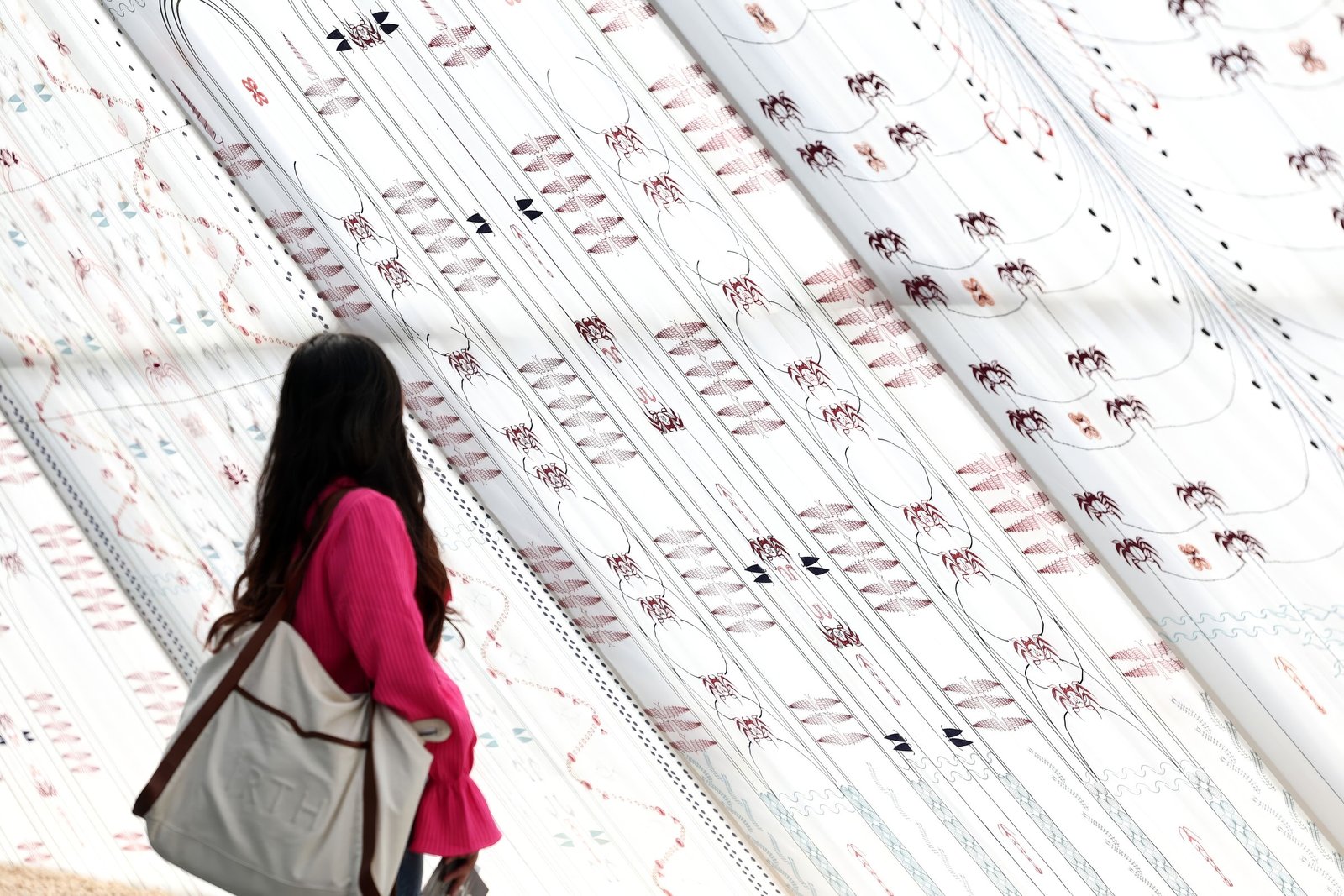
Inside the Abwab exhibition, which relocated indoors this year under the theme In Other Words, five commissioned works from Asian and African practitioners explore communication beyond language. The gesture is more than conceptual. Works draw from Kashmiri weaving notation, Devanagari typography, and handmade paper textures, each a system of marking that carries knowledge, tradition, and the risk of erasure.
Designer Varsha Rani Solanki’s contribution emerges from five years of research among Karnataka shepherds, documenting how traditional craft communities worldwide are losing indigenous skills and livelihoods. The exhibition’s unnamed curator and head of programme framed the work this way: “All acts of communication involve a design decision of what’s being visible and how things are interpreted, shaped and held.” It’s a statement that cuts deeper than it sounds. Weaving notation isn’t neutral marking; it’s a language embedded in fiber, a way of passing skill that written language alone cannot capture. By bringing these systems into a gallery space, In Other Words signals that design doesn’t just solve problems. It preserves.
The Downtown Design fair ran from November 4 to 8 inside the district, hosting brands ranging from Trika Arabia and Bottega Living to Biscuit and 1971 Design Space. But the real weight of this year’s edition lies not in the commercial bracket but in how the week’s curation insisted on regional specificity, material knowledge, and the slow work of craft at a moment when design conferences typically traffic in speed and surface.
The 12th Edition’s Real Stakes
Dubai Design Week’s 12th iteration runs through November 8, a relatively compact timeframe that has nonetheless crystallized around two forceful ideas: that atmosphere matters more than novelty, and that regional traditions contain urgent knowledge. The festival brought together fairs, exhibitions, installations, talks, and markets, but the work that lingered was the work that made you feel something shift. Three Gardens and a Room does that by removing you. In Other Words does it by making visible what was almost invisible, systems of notation and handwork that underpin entire cultures.
Neither installation requires a manifesto. The gravel speaks. The weaving speaks. The precision of the colour choice at noon speaks. In a design calendar crowded with tributes to surface and speed, that restraint reads as radical.