Bvlgari Titanio: Twenty-eight years after rubber and aluminum redefined sport luxury, Bvlgari replaces its signature material with grade 5 titanium.
When Bvlgari first paired aluminum with rubber in 1998, it was a provocation. Luxury watches didn’t do rubber straps. They didn’t do aluminum cases. They certainly didn’t do both together, especially not from a house known for serpentine jewelry and Roman grandeur. Now, nearly three decades later, the Bvlgari Titanio collection marks the end of that aluminum era, introducing grade 5 titanium as the new material foundation for this cult-beloved line.
Nearly three decades later, Bvlgari has decided the conversation has moved on. Enter the Titanio line, which swaps the original material recipe for grade 5 titanium, a metal that carries a different set of stories entirely. This isn’t simply an upgrade. It’s a philosophical reset for one of luxury’s most unlikely success stories.
Bvlgari Titanio Shifts From Rubber and Aluminum to Brushed Titanium
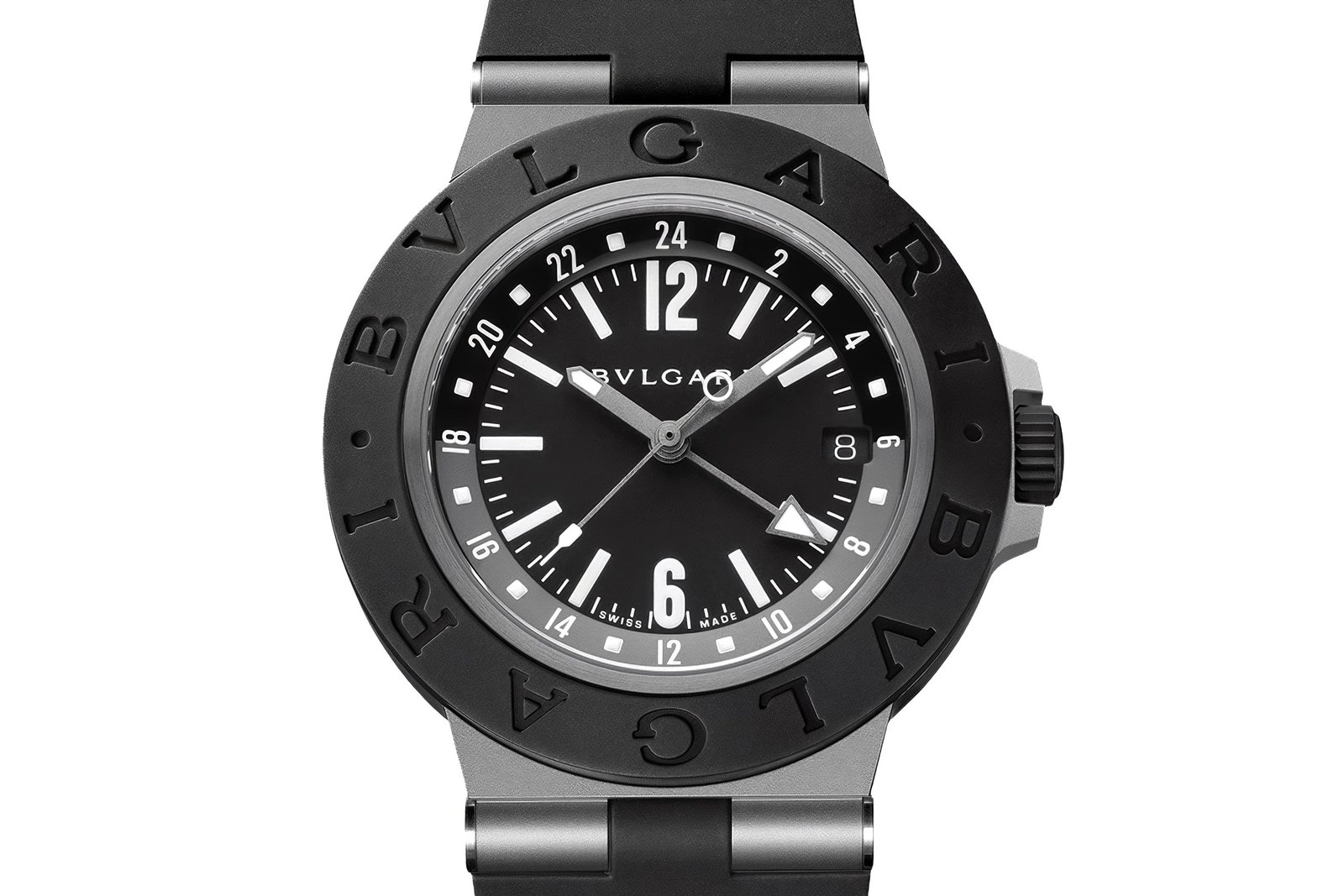
The shift announces itself in the details. Both new Titanio models, the GMT and the Chronograph, arrive in 40mm cases sculpted from brushed titanium and finished with contrasting matte and glossy surfaces. The collection’s signature engraved double-logo bezel remains, a through-line that roots the new design language in its heritage. But titanium operates at a different frequency than aluminum. It’s denser, more resilient, and carries industrial overtones that align the watch with aerospace engineering rather than playful defiance.
The Titanio GMT pairs the material shift with a complication for the globetrotter, powered by the automatic B192 caliber and offering a 50-hour power reserve. The Titanio Chronograph takes the same sport-chic language in a more technical direction. Both represent the continuation of a design story that began in 1998, when Bvlgari challenged conventional ideas of what a luxury sport watch could be. That challenge remains baked into the DNA of these new models, even if the material grammar has shifted entirely.
Timing and Venue: Geneva Watch Days 2026
The reveal comes amid a broader transformation in how luxury watchmaking presents itself to the world. The Titanio models emerged within the landscape of Geneva Watch Days 2026, held at the Palais Eynard in Geneva, Switzerland, an event that itself represents a cultural reset in horology. What began in 2020 as a decentralized pandemic experiment with eight founding brands, including Bvlgari, has grown into a record-breaking fixture. This year, 71 brands participated, a dramatic expansion from the original eight that included Breitling, De Bethune, Girard-Perregaux, H. Moser & Cie, MB&F, Ulysse Nardin and Urwerk.
Geneva Watch Days 2026 specifically rejected the gatekeeping model of traditional trade shows, instead designing itself around what Geneva Watch Days president Jean-Christophe Babin called a “fluid mix of historic watch houses, rebellious independent creators and emerging global brands.” In his opening address, Babin articulated the why behind this shift. He noted that brands must focus on emotional connection rather than status, and that watchmaking’s future depends on the ability to surprise and reinvent. “It is through creativity and boldness that we strengthen the desirability of our creations, spark desire and fuel passion,” Babin said, positioning the Titanio’s arrival squarely within a moment when horology itself is being democratized.
Why Titanium Matters More Than Material
On the surface, the swap from aluminum to titanium reads as a natural material progression. Titanium is stronger, more scratch-resistant, and carries prestige baggage that aluminum never quite managed to shake, no matter how well-designed the watch. But the deeper move here is cultural. The original Aluminium collection succeeded because it felt like an outsider move, a luxury brand slumming it in accessible materials. Titanium strips away that provocation. It’s a premium material by any measure, and it aligns Bvlgari with the aerospace and technical worlds in ways aluminum never could.
What most collectors will miss is the timing of this shift relative to Geneva Watch Days’ own democratization. The Titanio arrives not as a celebration of luxury exclusivity, but as evidence that the market’s relationship to status itself has fractured. A brushed titanium chronograph with a 50-hour power reserve is technically superior to its aluminum predecessor, but it’s also more obviously expensive, more obviously “correct.” The 1998 Aluminium collection said you could have refinement without reverence. The Titanio GMT and Chronograph say something closer to: you can have technical mastery and design audacity at the same time, but you’re going to pay for both.
The Bvlgari Titanio represents the end of an era and the beginning of another, arriving at a moment when the watch industry itself is being remade in real time. The rubber-and-aluminum formula worked because it was weird. The titanium formula will work because it’s undeniably good.