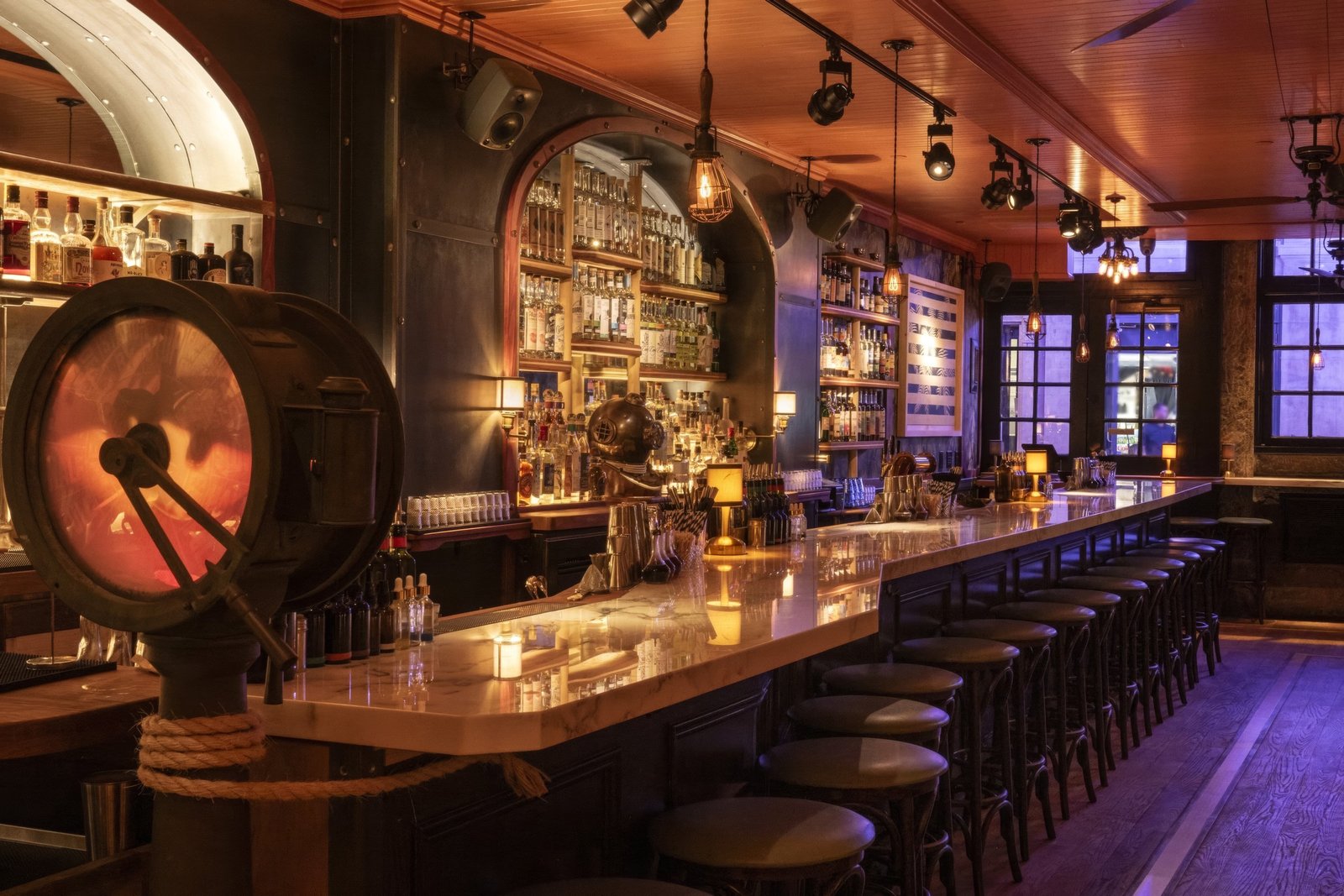
Below Deck Speakeasy: The Bedford’s underground cocktail concept arrives as New York’s most elusive bar of the season, accessible only to those who know where to look.
Somewhere beneath the glass towers and marble lobbies of Manhattan’s Financial District, a door that doesn’t advertise itself is about to open. Below Deck speakeasy, a reservation-only maritime bar from The Bedford hospitality group, launches November 5 as the kind of venue that requires password knowledge and advance planning just to secure a seat. In an era when most cocktail bars blast their Instagram handles across every available surface, the deliberate opacity feels almost radical.
The concept taps into a very specific appetite in New York nightlife right now: exclusivity that isn’t purely about money or connections, but rather about discovery and effort. You can’t walk in off the street. You can’t find the address readily on Google Maps. The entire structure is built around the premise that access itself becomes part of the experience. For a city saturated with bar openings and over-indexed on transparency, Below Deck’s refusal to play that game registers as genuinely countercultural.
Below Deck’s Maritime Speakeasy Model and Strategic Restraint
The Bedford, the hospitality group behind this launch, understands the economics of scarcity. A reservation-only format immediately solves the chaos problem that plague high-profile bar openings: the Instagram crowds, the bottle-service dominance, the conversion of a drinking space into a photo opportunity. By capping the venue to reservation holders, the bar can actually control its atmosphere. There’s no standing-room madness, no door policy drama, no viral TikTok moments that compromise the actual drinking experience.
The maritime theming adds narrative weight beyond aesthetic preference. A speakeasy rooted in nautical imagery suggests something underground, something with history and secrecy built into its DNA. It’s not just a bar, it’s a place with a story already embedded in its concept. For guests, that framing means you’re not just ordering a cocktail at a new spot; you’re entering into a deliberate fiction, a kind of consensual role-play that elevates the entire transaction.
Why Reservation-Only Actually Works
The reservation-only model has gained serious traction among serious bartenders over the past few years, but it remains rare enough in New York that it still reads as a statement. It’s a pushback against the democratization of nightlife, against the notion that every bar should be equally accessible to everyone at all times. Below Deck’s gatekeeping isn’t elitist in the traditional sense. It’s architectural. The limitation creates conditions under which real hospitality can flourish instead of getting flattened by volume.
For bartenders, the advantage is obvious: you know exactly who’s coming, you can prepare properly, you can execute without improvising for unexpected crowds. For guests, the friction of booking ahead acts as a filter. The people who show up have intentionally chosen to be there, which means they’re more likely to engage with what’s being presented rather than treat the bar as a backdrop for social media content.
The November 5 launch arrives at a moment when New York’s bar scene is overheating with new openings. According to Eater NY’s November 2026 guide, the month has already seen multiple significant debuts: Delphine Brasserie opened October 29 at the Ace Hotel in Nomad with four hospitality veterans (Karim Amatullah, KyKy Conille, Mino Habib, and Mathias Van Leyden) at the helm; June Baby, a Filipino American cocktail bar co-owned by Roxanne Diaz Bangalan and Darwin Pornel, opened October 28 in the East Village; Rosette, a French-leaning wine bar helmed by chef Cali Faulkner and wine director Lauren Goldfarb, opened November 3 in the West Village. Against that noise, a bar that refuses to announce itself has distinct appeal.
The Financial District Becomes a Nightlife Destination
The placement in the Financial District is strategic. It’s not a neighborhood known for cutting-edge nightlife. It’s where people work, not where they go to be seen. That underutilization becomes an asset for Below Deck. The area has the infrastructure (reliable foot traffic during certain hours, security, infrastructure) but lacks the saturated bar culture that makes neighborhoods like the East Village or the Lower East Side feel exhausted. A hidden speakeasy in the Financial District becomes genuinely difficult to stumble upon, which is precisely the point.
Against the noise of competing November openings, a bar that refuses to announce itself has distinct appeal. Below Deck speakeasy represents a deliberate counteroffensive to the oversaturation of the New York bar scene, choosing exclusivity and intentionality over accessibility and volume. The Financial District placement underscores this philosophy: it’s where people work, not where they go to be seen, making Below Deck speakeasy an unexpected refuge for those seeking genuine hospitality over Instagram moments.