Barcelona Pavilion: A temporary artistic intervention transforms one of modernism’s most austere monuments into a disorienting maze of reflections and sight lines.
Starting today, November 12, the Barcelona Pavilion, that austere steel-and-marble temple to geometric purity designed by Mies van der Rohe and Lilly Reich for the 1929 International Exposition, becomes something it was never meant to be: a labyrinth. For the next ten days, architects Ciro Najle and Josep Ferrando will occupy the space with an installation called “Pavilion-Labyrinth” that remakes the building’s entire spatial logic by introducing walls of glass that obscure, redirect, and multiply the visitor’s path through one of architecture’s most sacred modernist spaces.
The Barcelona Pavilion has endured an unusual afterlife. Originally constructed as a temporary representation of modern Germany in the post-World War I moment, the building was dismantled after the exposition closed. The Fundació Mies van der Rohe, established in 1983 by the Barcelona City Council, later reconstructed it faithfully from archival documentation. Since its resurrection, the pavilion has operated as both architectural landmark and cultural venue, occasionally hosting visual artists and short-term exhibitions within its carefully proportioned rooms. The building is managed by the foundation and remains one of the most visited modernist structures in Europe, drawing architects, students, and cultural pilgrims who come to experience Mies’s radical reduction of form to its essential elements.
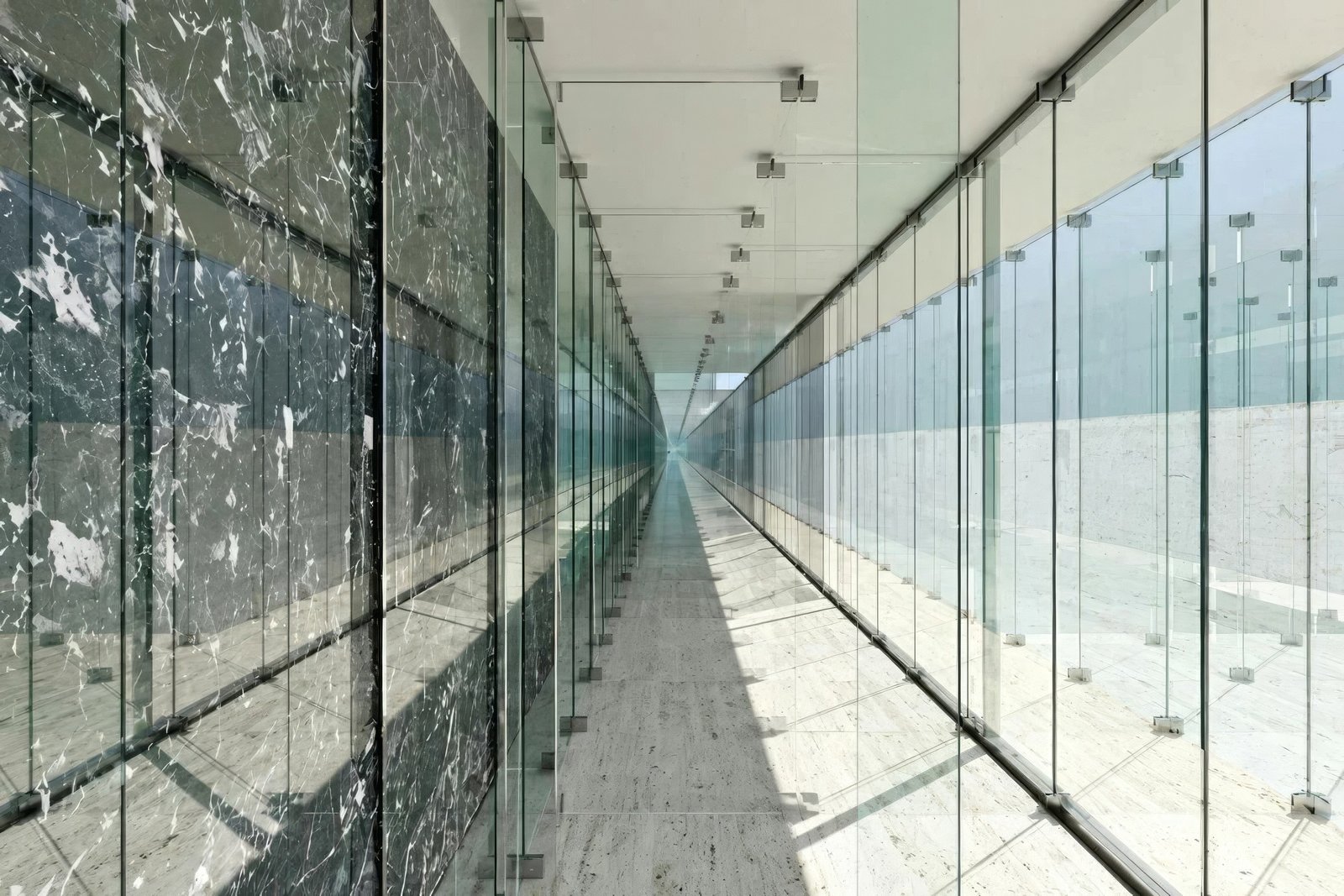
The Najle and Ferrando intervention exploits the pavilion’s defining characteristic: its seamless dissolution of boundaries between interior and exterior, achieved through continuous planes of glass, stone, and reflective surfaces. By introducing new glass partitions, the artists are not contradicting that principle so much as weaponizing it. Visitors entering the installation will encounter a maze constructed entirely of glass, a material that signals transparency while frustrating passage and sight lines. The intervention plays with the phenomenological experience of the space, turning the pavilion’s famous openness into a perceptual trap. Where Mies sought clarity through elimination, Najle and Ferrango achieve disorientation through multiplication of the same material logic. The labyrinth runs from November 12 through November 22, 2026, a deliberate brevity that positions the work as an artistic interruption rather than a permanent alteration.
This type of intervention has become increasingly common at landmark buildings, allowing institutions to generate audience interest and cultural conversation while asserting that even canonical modernist spaces remain active sites for contemporary practice. The Barcelona Pavilion’s programming strategy reflects a broader museum and heritage philosophy: the building itself is the artifact, but the building can also be a stage. By hosting artists like Najle and Ferrango, the Fundació Mies van der Rohe sustains the pavilion’s relevance beyond pure preservation. Each temporary intervention asks whether modernism is a fixed historical moment to be protected in amber or a set of spatial and conceptual problems that remain generative for living artists.
The logistics of staging art inside the pavilion require precision. The building’s spare geometry, its open floor plans, and its emphasis on sight lines mean that any insertion must reckon with the existing spatial order. A labyrinth of glass will create new visual boundaries while maintaining the transparency that defines the structure. Visitors moving through the maze will encounter multiple reflections of the pavilion’s iconic elements: the travertine walls, the cruciform steel columns, the Barcelona chairs. The glass partitions will bounce these images back and forth, complicating the sense of where the pavilion ends and the labyrinth begins. For ten days, the space becomes a collaboration between two architectural visions separated by nearly a century.
The timing and brevity of the intervention are deliberate curatorial choices. A ten-day run ensures that the pavilion returns to its canonical state, that the installation functions as an event rather than a renovation. This approach respects the building’s historical status while refusing to treat it as untouchable. It acknowledges that architecture, even modernist architecture, can be contested, reframed, and temporarily occupied by new ideas without losing its integrity. The Barcelona Pavilion has survived reconstruction, decades of shifting architectural theory, and countless interpretations of its significance. A glass labyrinth that lasts ten days is just the latest chapter in its ongoing cultural life.