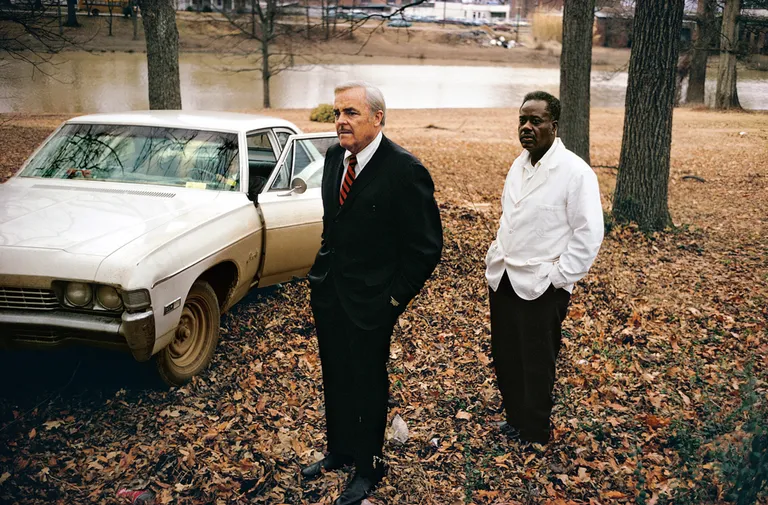
William Eggleston London: The colour photography pioneer opens his most comprehensive UK exhibition at The Photographers’ Gallery, half a century after his visionary Guide changed everything.
William Eggleston is finally getting his London moment. The Photographers’ Gallery is staging ‘All That Goes Unnoticed,’ a major retrospective that traces the Mississippi-born artist’s journey from technical outlaw to acknowledged master of colour photography. Opening this October, the William Eggleston London show represents the most substantial UK survey of his work to date and arrives as a kind of deferred recognition for an artist whose influence has quietly shaped how the entire medium sees the world.
The exhibition’s framing is deliberate. Fifty years ago, Eggleston’s “Guide” landed like a manifesto, a collection of saturated, seemingly casual snapshots that proved colour film could be serious art. Museums dismissed it. Critics called it amateurish. What Eggleston had actually done was collapse the distance between vernacular photography and fine art, stripping away the grey-scale solemnity that had defined the form’s “high” tradition. He pointed his camera at carports, shopping trolleys, parking lots, electrical wires, and the blunt American South, subjects that weren’t supposed to matter, and rendered them with such formal precision and chromatic intelligence that they became impossible to ignore. That move wasn’t just a stylistic shift; it fundamentally rewired what photographs could claim to be about.
‘All That Goes Unnoticed’ doesn’t position Eggleston as historical curiosity or elder statesman. Instead, the William Eggleston London exhibition recounts his method: the refusal to separate the mundane from the meaningful, the insistence that colour itself could carry emotional and philosophical weight, the belief that attention, real, sustained attention, transforms anything into something worth seeing. His work continues to frame contemporary photography’s obsession with the ordinary, the overlooked, and the transformative power of vision.