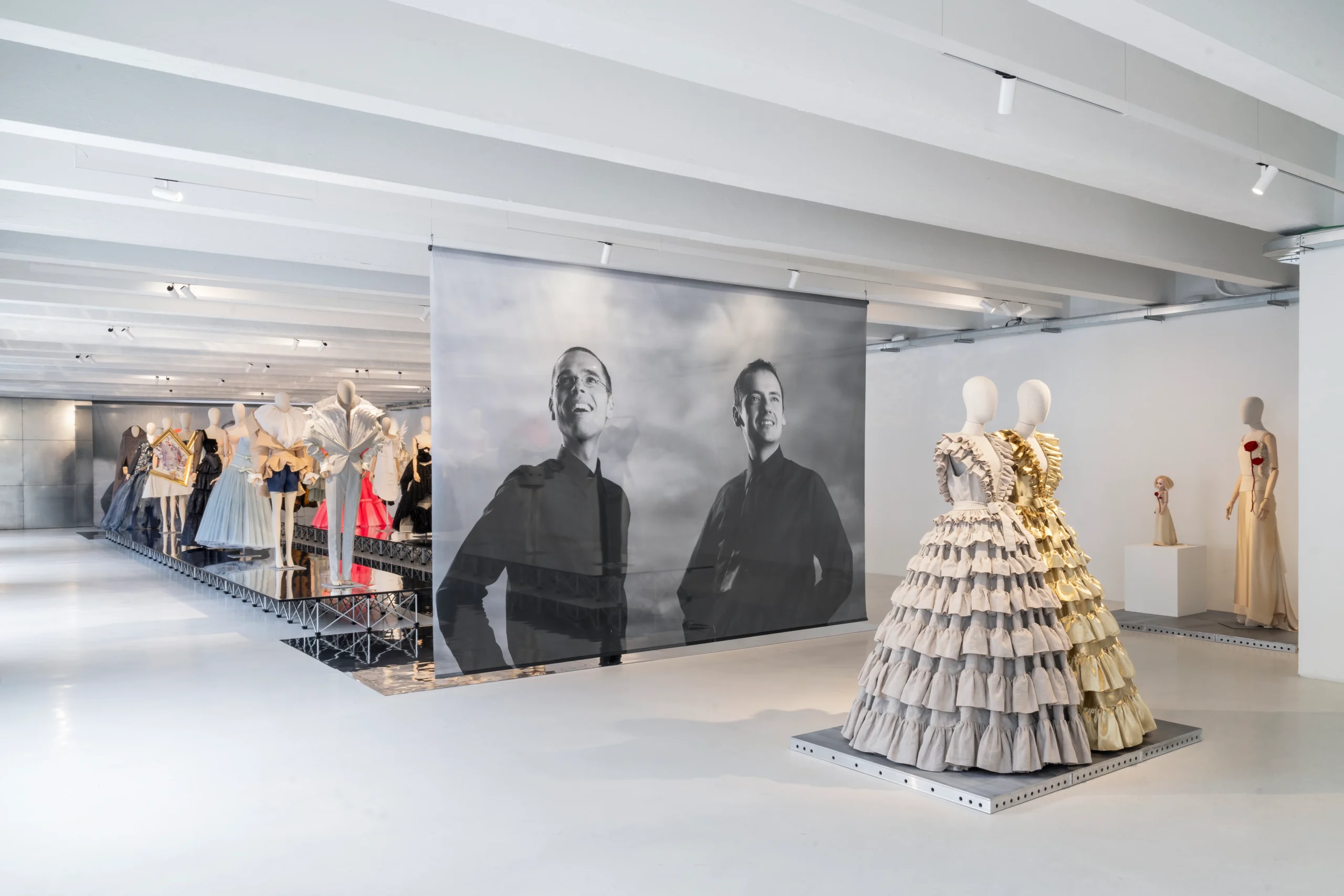
Viktor&Rolf Spectrum: The Dutch design duo presents two decades of haute couture experimentation as gallery-installed ideas about clothing, silhouette, and the politics of beauty.
Viktor Horsting and Rolf Snoeren have spent their careers asking a question most fashion houses never dare to articulate: what if clothing existed not to flatter or trend, but to challenge how we see ourselves? That interrogation becomes tangible this November in Milan, where Viktor&Rolf Spectrum installs 20 haute couture looks across three decades of the Dutch designers’ practice, framing garments as conceptual works rather than commercial objects.
The exhibition lands in November 2026, when Milan shifts away from Fashion Week’s runway frenzy into a deeper cultural moment. According to Milan Fashion Campus, the month offers fashion lovers, creative travelers, and aspiring designers a chance to experience the city’s creativity beyond traditional show schedules. Viktor&Rolf. Spectrum fits neatly into this curatorial approach, treating the relationship between clothing, artistic expression, and conceptual design as the central subject rather than seasonal product.
Viktor&Rolf Spectrum: Two Decades of Refusal
Horsting and Snoeren have built their entire practice on what amounts to a sustained refusal of fashion convention. Rather than follow trends, the pair has consistently used garments to communicate ideas. The Spectrum exhibition crystallizes this methodology by pulling 20 haute couture looks that span roughly 30 years of experimentation. Each piece functions less like a dress or coat and more like a statement about what dressing the body can mean.
The curation deliberately positions these works as art objects worthy of gallery contemplation. Visitors encounter them not on a runway at speed, but installed in space where questions about silhouette, beauty standards, and the purpose of fabric become unavoidable. Milan Fashion Campus notes that this approach offers an opportunity to understand how designers can use garments to communicate ideas rather than simply follow trends.
Context and Timing
The Spectrum exhibition arrives in a November programming calendar that positions fashion as a legitimate visual and intellectual medium. Alongside Viktor&Rolf sits Dalí e la Moda, which examines Salvador Dalí’s relationship with fashion through more than 200 works and archival materials, including garments, jewelry, illustrations, photographs, and objects. That show traces how surrealism influenced fashion’s visual language, particularly through Dalí’s famous creative relationship with Elsa Schiaparelli. The parallel programming suggests a deliberate curatorial stance: that fashion history and conceptual design merit the same institutional gravity as fine art.
Palazzo Morando, located in Milan’s famous fashion district, simultaneously presents Abiti in scena. Mosè Bianchi e il sogno del Settecento, an exhibition exploring the relationship between eighteenth-century clothing and nineteenth-century painting. Historical garments collected by the painter Mosè Bianchi hang alongside artworks in which they appeared, demonstrating how clothing constructs characters, atmosphere, and storytelling across centuries.
The Broader Conversation
Viktor&Rolf. Spectrum doesn’t exist in isolation. The exhibition participates in a November moment where Milan’s cultural institutions have decided to make visible the connection between fashion and art as a category problem rather than a stylistic one. At MUDEC, the Matisse. The World in a Room exhibition invites visitors to examine how the artist developed his visual language through encounters with different cultures and artistic traditions. For fashion practitioners, the show models how artistic references can become the foundation of new collections. American artist Sheila Hicks’s In the Thread of Love operates in similar terrain, transforming familiar textile materials such as wool, cotton, and linen into expressive artworks that explore texture, color, craftsmanship, and the relationship between material and space.
The convergence reflects an institutional recognition that fashion design, when practiced at this level of intentionality, demands to be read alongside painting, sculpture, and textile art. Viktor&Rolf have always understood this. Spectrum simply makes the case visible in one of the world’s fashion capitals, during a month when the city pauses long enough to look.
Sources: milanfashioncampus.eu