Toyota Innova Hycross Facelift: Toyota’s bestselling MPV gets its first major refresh in four years, debuting a bioethanol-powered variant that could reshape India’s alternative fuel landscape.
The Toyota Innova HyCross facelift is dropping on November 25, 2026, and the refresh carries real stakes. This is the premium MPV’s first major update since launch in 2022, and it arrives with a claim that could shift India’s automotive conversation: a 100% bioethanol-powered E100 variant using a modified strong-hybrid powertrain. Union Road Transport and Highways Minister Nitin Gadkari has already announced the flex-fuel drop, signaling government backing for what could be India’s first E100 strong-hybrid production vehicle.
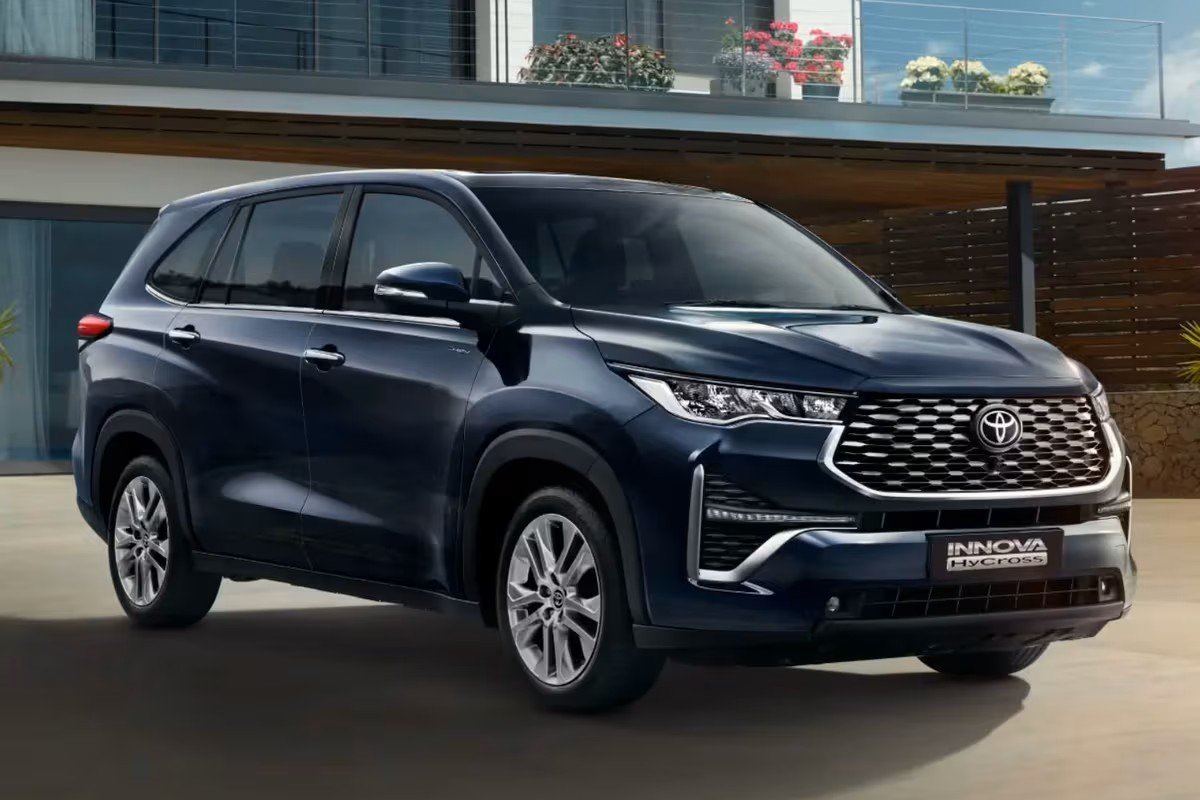
The teaser reveals a facelift philosophy built on reduction rather than maximalism. While the overall silhouette remains familiar, test mule sightings show a more upright stance and a refreshed front end. A new slatted grille design appears likely, with similar patterning extending to the lower fascia. The design language prioritizes visual cleanliness, stripping away unnecessary elements at the front. Sharper lighting elements are expected, though the side profile holds largely unchanged except for possible new alloy wheel designs. At the rear, the facelift points toward a flatter tailgate and less visually aggressive bumper treatment, continuing the decluttering theme. The existing quad-beam dual-tone ORVMs with integrated turn signals, chrome door handles, window garnish, shark fin antenna, roof-mounted spoiler, and raked windshield carry forward.
Toyota Innova HyCross Facelift: The Flex-Fuel Breakthrough
The real news lives under the hood. Toyota already showed a HyCross-based flex-fuel strong-hybrid prototype equipped with a modified 2.0-litre four-cylinder petrol engine paired with hybrid tech and components engineered specifically for higher ethanol blends. The standard current HyCross is E20 compliant, meaning it handles up to 20% ethanol blending. A flex-fuel E100 variant opens the door to 100% bioethanol operation on the same vehicle, a technical pivot that Toyota has validated through prototype testing. If launched as announced, this could position India’s MPV market at the intersection of hybrid efficiency and sustainable fuel sources, a rare combination in this segment.
Current HyCross specs remain familiar. The petrol variant runs a 2.0-litre engine producing 172.99 hp and 204 Nm of torque, paired with CVT transmission, priced from Rs 19.53 lakh to Rs 21.12 lakh (ex-showroom). The strong hybrid variant uses the same 2.0-litre engine combined with an electric motor and battery pack, generating 186 hp and 191 Nm through an e-Drive sequential shift transmission, ranging from Rs 26.76 lakh to Rs 32.95 lakh (ex-showroom). The flex-fuel E100 variant’s powertrain specs and pricing remain unconfirmed, though the prototype foundation suggests it will sit within or above the current hybrid tier.
Interior and Feature Parity
Interior design stays largely unchanged architecturally, but content and materials get refreshed. The existing layout of trapezoidal AC vents, simplified dashboard, automatic gear selector, raised centre console, and door-mounted seat adjustment controls remains. What’s likely new is the interior theme and upholstery treatments. Toyota recently updated the HyCross in Indonesia, where it sells as the Kijang Innova Zenix, introducing a 12.3-inch touchscreen infotainment system, a 7-inch TFT multifunction display, onboard Wi-Fi for all passengers, a 360-degree camera with panoramic view monitor, and front and rear digital video recorders. Several of these features could migrate to the Indian facelift variant, modernizing the cabin tech stack without overhauling the fundamental layout.
The HyCross currently holds Toyota’s second bestselling position in India, making this refresh a volume-critical move. The addition of a flex-fuel option elevates the story beyond a cosmetic and feature update into territory where environmental policy, hybrid technology, and sustainable fuels converge. For buyers tracking alternative powertrains, November 25 marks the moment India’s MPV market shifts.