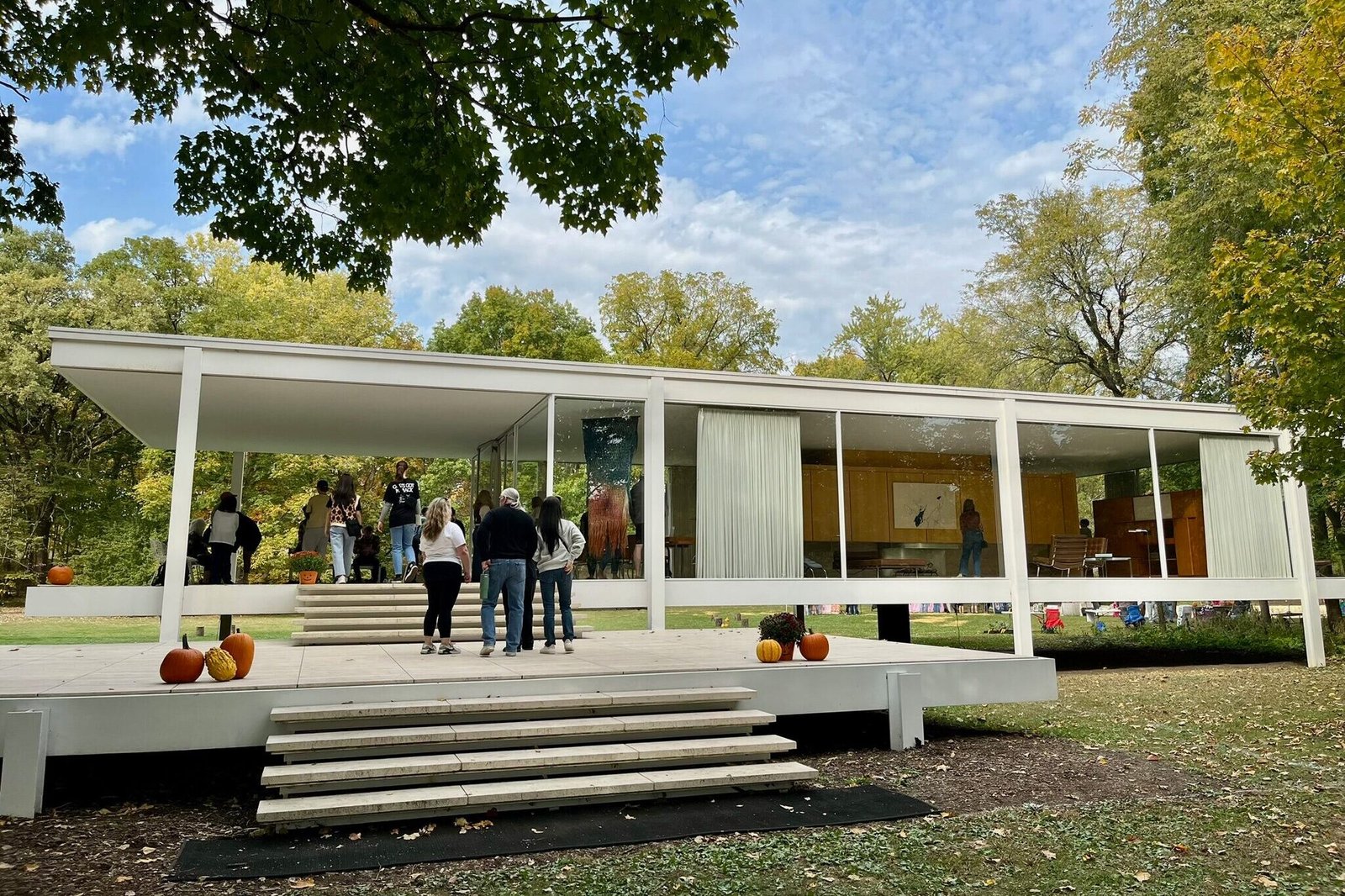
Mexican Modernism: A landmark show at Mies van der Rohe’s iconic home reframes Mexico’s design revolution as a genuinely original movement, not a footnote to European modernism.
Mexican modernism gets its reckoning. For decades, the country’s radical architectural and design output from the 1930s through the 1970s has lingered in the shadow of European giants, a regional variation rather than a primary force. That erasure ends this season when a major exhibition at the Farnsworth House in Plano, Illinois, positions Mexico’s modernist boom as a genuinely autonomous cultural movement that rewrote the rules of how buildings, interiors, and public spaces could function in a postcolonial context.
The timing of the show is deliberately provocative. The Farnsworth House, completed in 1951 and designed by Mies van der Rohe, stands as a temple to European minimalism and the International Style. Hosting an exhibition that frames Mexican modernism as a parallel, equally valid conversation, rather than a tributary of Mies or Le Corbusier, is a curatorial statement in itself. The exhibition traces how Mexico’s architects and designers synthesized indigenous materials, indigenous spatial logic, and postrevolutionary ideology into something that looked nothing like what was happening in Berlin or Barcelona. The movement wasn’t importing European codes; it was building from first principles, rooted in place.
What most observers will miss is the exhibition’s insistence on Mexico’s modernism as fundamentally a social project. While European modernism often centered on form and the pristine object, Mexican practitioners embedded their work in education, housing, and public infrastructure. Luis Barragán’s use of color and light wasn’t abstract aesthetics, it was a response to specific climate, culture, and community need. The same logic applied to industrial designers, ceramicists, and furniture makers who treated modernism not as a style to adopt but as a tool for national reconstruction. The show doesn’t position these figures as rebels against the International Style; it makes clear they were operating in an entirely different register, with different stakes and different sources of meaning.