The aerial artist plants her signature floating form in the heart of a European city.
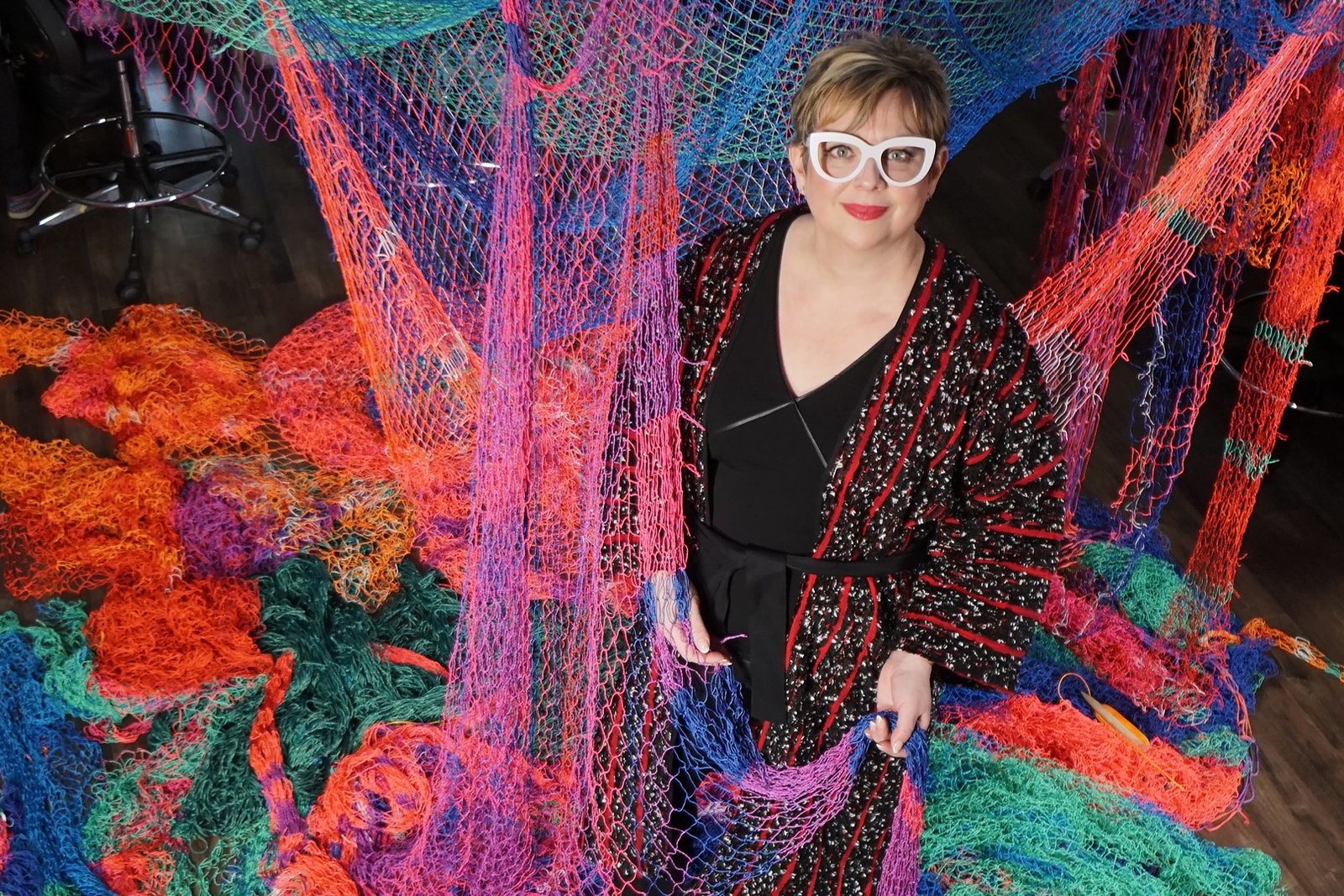
A 12-metre mesh structure now hangs suspended above Frankfurt’s central square, casting shadows that shift with the light and wind. The work belongs to Janet Echelman, the net artist who has spent two decades transforming public space into something between sculpture, fabric, and air itself. This isn’t a billboard or a monument in any traditional sense. It’s a form that breathes, that moves, that asks pedestrians to look up and recalibrate what a public artwork can be.
Echelman’s vocabulary is distinctive: tensioned netting in bold geometries, suspended from minimal points, designed to catch both light and motion. Her pieces exist at a scale that dominates a space without crushing it, engaging the entire surrounding architecture through their presence. The Frankfurt installation lands in one of Europe’s oldest city centers, a medieval square now surrounded by modern commerce and foot traffic, making it an ideal testing ground for work that operates at the intersection of monument and movement.
What sets Echelman apart from the Instagram-art cycle is durability of concept. Her sculptures aren’t meant to photograph well and disappear. They’re meant to be lived around, walked under, watched at different times of day and seasons. A net catches light differently at dawn than at dusk. Wind loads it differently in summer than in winter. The sculpture becomes a dial measuring the invisible forces moving through the city itself.
For Frankfurt, the piece engages both the plaza’s history and its contemporary rhythm. Tourists, commuters, and locals all move beneath it, and the work refuses to perform in any single style. It’s as much product of engineering as it is art, as much about structural tension as visual form. That hybrid identity has defined Echelman’s career: she doesn’t make sculptures that happen to float. She makes floating things that become sculptures through the act of looking.