Mies van der Rohe’s modernist masterpiece opens Fertile Ground on August 23, an exhibition designed around the iconic architecture rather than against it.
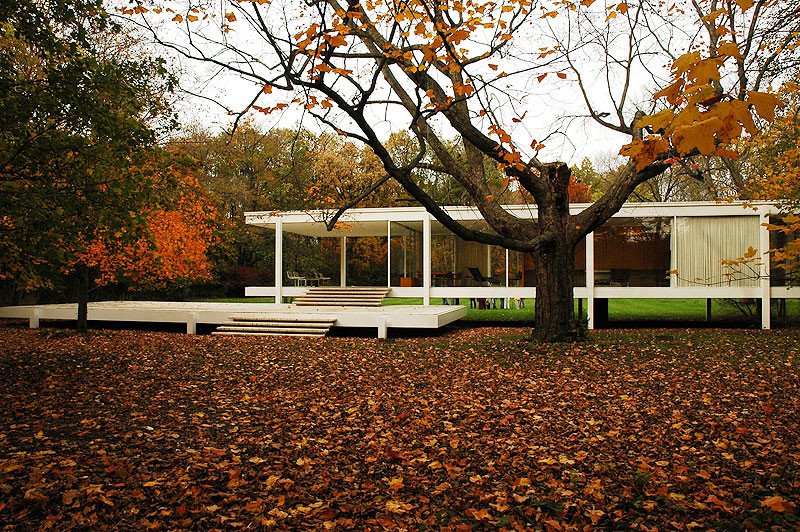
Farnsworth House, Mies van der Rohe’s canonical 1951 glass and steel residence near Plano, Illinois, is marking seven and a half decades of existence with an exhibition that refuses to compete with its own walls. Opening August 23, Fertile Ground positions the landmark building as the primary artistic statement, with curatorial choices designed to activate and highlight rather than overshadow the structure’s skeletal geometry and relationship to its surrounding landscape.
The approach signals a maturation in how institutions steward modernist icons. Rather than fill the spare interior with objects that fragment attention, the exhibition uses the Farnsworth House’s signature elements, its transparency, its floating platform, its blurred boundary between interior and exterior, as the organizing principle itself. Every element on view has been considered in dialogue with Mies’s original spatial logic.
The timing reflects broader institutional momentum. As foundational modernist buildings enter their eighth decade, museums and heritage sites are moving beyond preservation-as-archive toward interpretive projects that reactivate these spaces for contemporary audiences. Fertile Ground joins a growing category of exhibitions treating architecture not as neutral container but as active collaborator in the curatorial gesture.