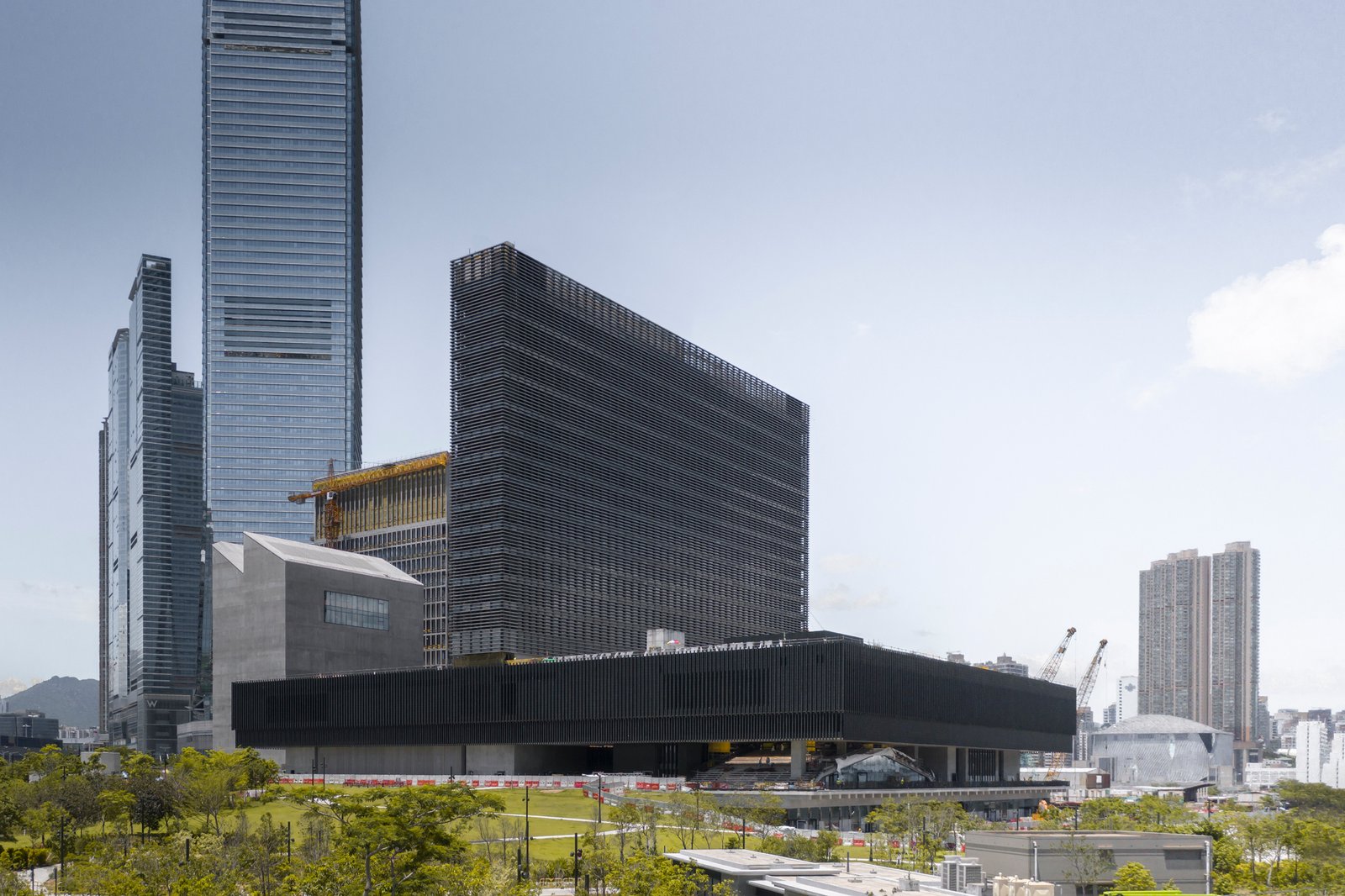
The Pritzker winners open their playbook at M+, revealing the messy, obsessive process behind buildings that rewire how we experience space.
Herzog & de Meuron don’t build like other architects. They collage. They layer. They borrow from geology, textiles, light itself. And now, at M+ in Hong Kong, they’re letting you inside the studio to watch how obsession becomes form.
The exhibition is not a retrospective in the conventional sense. This is no marble-clad victory lap of finished projects. Instead, M+ has secured access to the Swiss practice’s full creative apparatus: sketches, models, material experiments, rejected concepts, the stuff that usually stays in the studio. It’s rare for architects of this caliber to expose the thinking process so directly. Most prefer the myth of the flash of genius. Herzog & de Meuron have built their reputation on the opposite: that architecture emerges through relentless investigation, failure, and refinement.
What makes this moment significant is less about the show itself and more about what it signals about how serious collectors and institutions now view architecture. The fact that M+ devoted this much institutional weight to process over finished objects suggests a cultural shift. We’re past the Instagram-era obsession with the building as singular image. The conversation has moved to: How do ideas get made? What does a practice’s visual language actually reveal about its philosophy? For a firm that has spent thirty years insisting that architecture is a form of deep looking, that’s vindication.
The show lands at a moment when Herzog & de Meuron’s influence is everywhere, if you know where to look. Their DNA runs through contemporary practice in Asia and beyond. Seeing the source code matters. It’s the difference between admiring a building and understanding how to think like an architect.