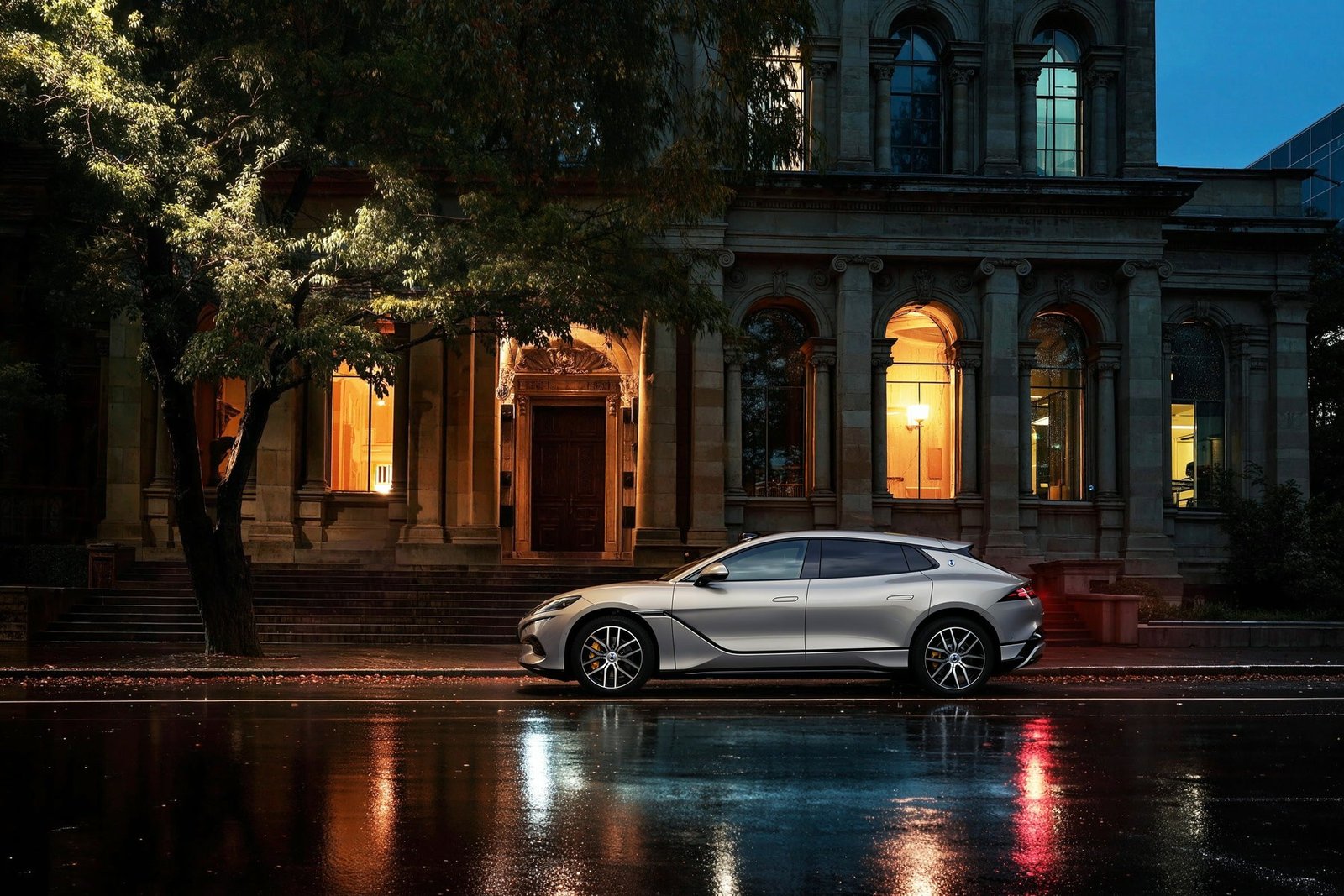
Denza Z9 Gt India: BYD’s luxury brand debuts its tri-motor shooting brake in India’s expanding premium EV market, priced between ₹1.2 crore and ₹1.5 crore.
On November 13, 2026, the Denza Z9 GT will officially enter the Indian market as BYD’s premium sub-brand unveils a high-performance electric shooting brake engineered to challenge the country’s nascent luxury EV segment. The launch marks Denza Z9 GT’s first appearance in India as a completely built unit (CBU) import, positioning the brand squarely in the ultra-premium tier where it will compete alongside established European marques and emerging Chinese luxury players.
Denza Z9 GT Spec Sheet: Power, Range, and Charging Speed
The Z9 GT arrives with credentials that read like a performance EV manifesto. Its tri-motor setup consists of one front electric motor and two rear units producing a combined 1,156 horsepower and 1,210 Newton-meters of torque across all four wheels. That power delivery translates to a claimed 0-100 km/h acceleration time of 2.7 seconds with a top speed of 270 km/h. The platform relies on a 122.5 kWh battery pack that Denza claims delivers a WLTP-rated range of 600 kilometers on a single charge.
Charging infrastructure remains a critical variable for ultra-premium EV buyers, and the Z9 GT addresses this with aggressive DC charging capability. According to Gaadiwaadi, the vehicle accepts up to 1,500 kilowatts of DC charging power and can reach a 10 to 97 percent charge in nine minutes, though this feat depends entirely on access to compatible ultra-high-power chargers, a rare commodity outside metropolitan charging networks. For context, the Mercedes-Benz GLC Electric launching on November 4 tops out at 330 kW of charging speed, which Gaadiwaadi reports adds approximately 300 kilometers in 10 minutes. The Mini Cooper SE, arriving November 27, accepts 95 kW.
Efficiency metrics reveal the Z9 GT’s heavier footprint compared to its EV peers launching the same month. When dividing claimed WLTP range by battery capacity, the Denza achieves roughly 4.9 kilometers per kilowatt-hour, the GLC Electric manages about 7.6 km/kWh, and the Mini achieves 7.4 km/kWh. The Z9 GT carries more than twice the Mini’s battery capacity yet delivers less than 1.5 times the range, a trade-off typical of heavier, high-performance platforms prioritizing power over efficiency.
Interior Luxury and Autonomous Features
The Z9 GT’s cabin reflects Denza’s positioning at the intersection of technology and opulence. The vehicle features heated, ventilated, and massaging seats across the cabin, a multi-screen dashboard architecture, and a 20-speaker Devialet sound system. Electrically operable doors and camera-based outside rearview mirrors replace conventional door handles and mirrors, while rear-wheel steering technology enhances maneuverability. The Z9 GT carries Level 2+ advanced driver assistance systems (ADAS), situating it alongside contemporary luxury EVs in terms of autonomous driving capability, though short of full autonomy.
Pricing and Market Position
Denza has positioned the Z9 GT at ₹1.2 crore to ₹1.5 crore, placing it above the simultaneously launching Denza D9 luxury MPV, which is expected to retail between ₹90 lakh and ₹1.1 crore. By November 2026 standards, the Z9 GT’s pricing strategy targets India’s growing cohort of ultra-high-net-worth individuals seeking alternatives to traditional German luxury sedans and SUVs. The Mercedes GLC Electric, arriving two weeks prior, carries an estimated price tag of ₹80 lakh to ₹90 lakh, making the Z9 GT’s entry point roughly 33 percent higher, a premium justified by its acceleration performance and battery capacity.
The November 2026 launch calendar reflects a dramatic acceleration in premium EV availability within the Indian market. Three electric vehicles and one strong hybrid are scheduled across the month: the Mercedes GLC Electric on November 4, the Denza Z9 GT on November 13, the updated Toyota Innova Hycross (expected November 25, though Autocar India notes this date as provisional) with a new 2.0-liter strong hybrid engine, and the second-generation Mini Cooper SE with the Paul Smith Edition on November 27. The Mini’s 54.2 kWh battery delivers 218 horsepower and 330 Newton-meters, achieving 0-100 km/h in 6.7 seconds with a 402 km WLTP range and a 10 to 80 percent DC charge in just under 30 minutes at 95 kW.
The November 2026 launch calendar reflects a dramatic acceleration in premium EV availability within the Indian market, with the Denza Z9 GT joining the Mercedes GLC Electric, Toyota Innova Hycross strong hybrid, and Mini Cooper SE across the month. For ultra-high-net-worth individuals seeking alternatives to traditional German luxury sedans, the Denza Z9 GT represents a compelling proposition, combining hypercar-grade acceleration with the sophistication expected at its ₹1.2 to ₹1.5 crore price point.