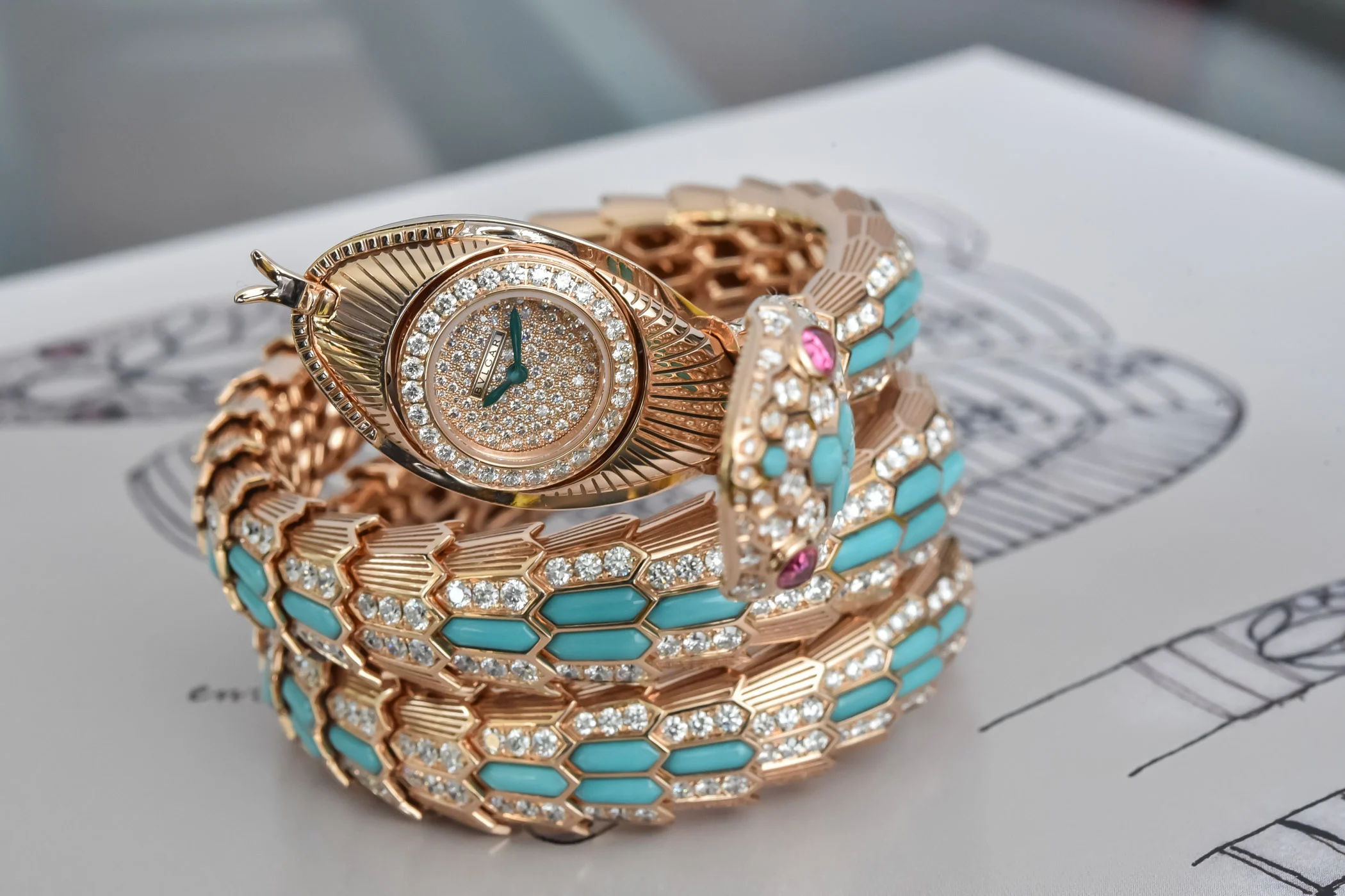
The Serpenti doesn’t move. It breathes. Somewhere between the tenth and eleventh avenue footbridge on New York’s High Line, Bvlgari’s Serpenti Infinito project unfolds as a 30-foot pneumatic sculpture by Berlin-based collective Plastique Fantastique, filling and emptying in a hypnotic rhythm. Its body is a gleaming monument to the snake that’s been coiling around Bvlgari’s wrists and necks for decades. The work, titled “auruBOROS,” riffs on the mythological serpent consuming its own tail, a fitting metaphor for a luxury house that’s spent the better part of a century perfecting the art of circular seduction: the snake eats the jewelry, the jewelry eats the narrative, the narrative eats your desire to own it.
Bvlgari’s Serpenti Infinito project began as a gallery concept in Europe, a series of artist commissions meant to blow up the jewelry line into something spatial, experiential, architectural. Plastique Fantastique, known for their site-responsive inflatable installations that occupy the liminal spaces between sculpture and spectacle, understood the assignment immediately. Their material is air itself. The pneumatic tubes and silicone membranes create something that reads as both monumental and provisional, a $400,000 dress code for a moment that could theoretically deflate tomorrow. It won’t, but that possibility is the work’s secret pleasure. The sculpture’s surface catches light like polished gold, mimicking the warm glow of Bvlgari’s signature metal finish, but the material undermines the permanence usually coded into luxury objects. Here, inflation equals immortality, and only as long as the compressors run.
The High Line installation marks the first time Bvlgari has brought the Serpenti Infinito project to the United States, a significant bet on art as a vehicle for brand elevation at a moment when New York’s cultural landscape is reshaping what luxury means. By partnering with Plastique Fantastique, Bvlgari Serpenti Infinito transcends traditional jewelry marketing, inviting visitors to experience the mythology and materiality of its most iconic symbol as a living, breathing artwork.